
The books in this section are not about BCCI. They are included to provide a wider context in which readers can consider allegations of money laundering, market manipulation, sanctions violations, weak controls and other serious misconduct involving major international banks.
Their inclusion does not suggest that the circumstances were identical to BCCI. Rather, they allow comparison of the scale of wrongdoing, the language used to describe it, the responsibility attributed to individuals and management, and the regulatory remedies applied to the banks concerned.
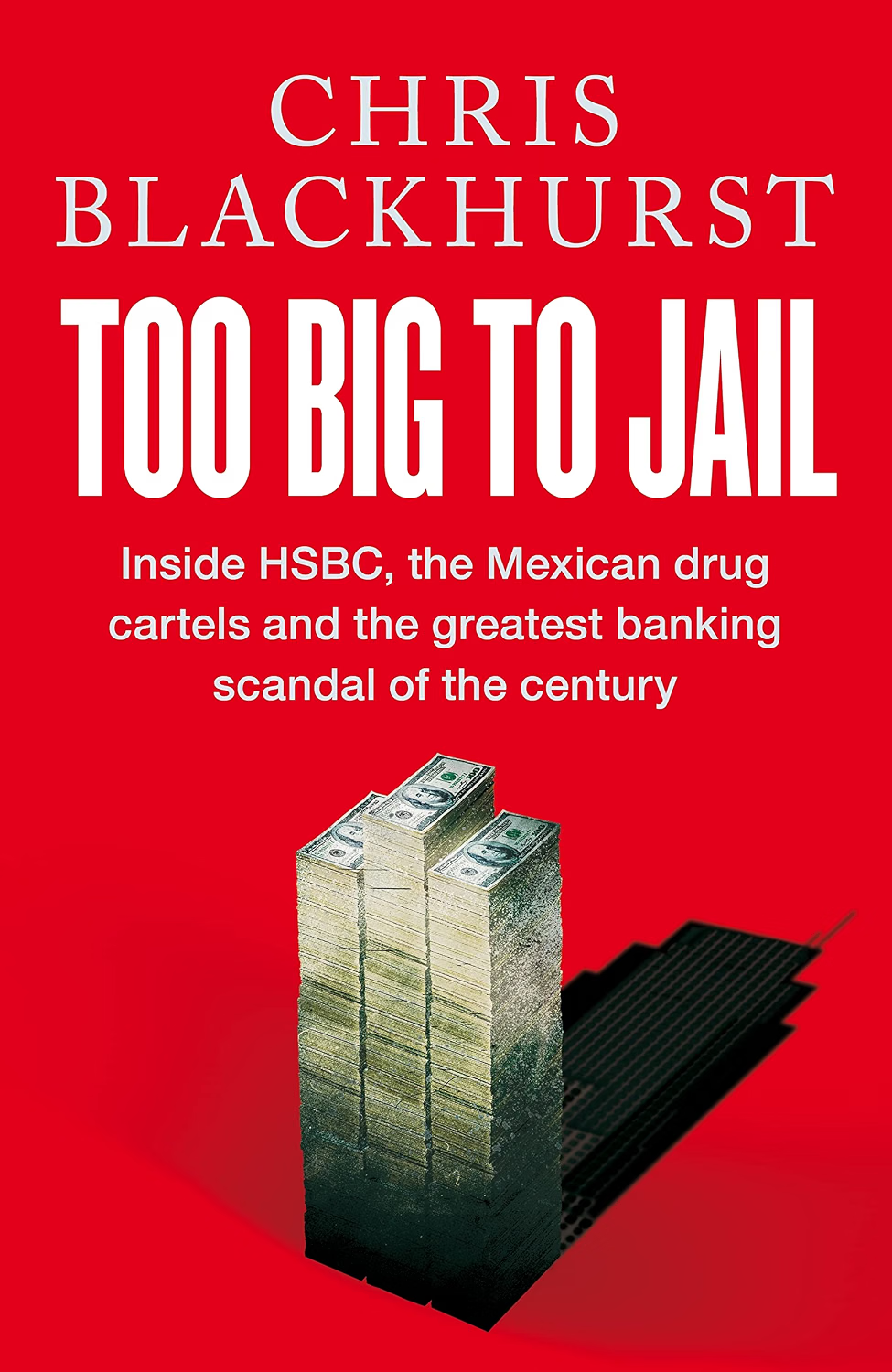
Too Big to Jail: Inside HSBC, the Mexican Drug Cartels and the Greatest Banking Scandal of the Century
Too Big to Jail, published in 2022 and written by by British journalist and former Independent editor Chris Blackhurst, examines the money-laundering failures that led HSBC to enter into a deferred prosecution agreement with United States authorities in 2012.
The book focuses particularly on HSBC’s operations involving Mexico and the movement of funds connected with drug-trafficking organisations. The US Department of Justice stated that HSBC Bank USA had failed to maintain an effective anti-money-laundering programme and adequate due diligence over correspondent banking. US authorities imposed penalties totalling more than US$1.9 billion, while the Department of Justice agreement included the forfeiture of US$1.256 billion and extensive compliance obligations.
Blackhurst’s central theme is contained in the title itself: “Too Big to Jail.” He examines why a major international bank facing extremely serious findings was permitted to continue operating rather than being prosecuted in a way that might have threatened its existence.
For readers examining BCCI, the comparison is important.
BCCI became closely identified with international money laundering following the 1988 Tampa investigation and was ultimately closed in 1991 while an Abu Dhabi-backed restructuring was under way. HSBC, by contrast, faced findings involving very large flows of drug-related money and serious failures of anti-money-laundering controls, yet regulators pursued financial penalties, monitoring and reform while allowing the bank to continue.
The circumstances were different and should not be treated as identical. Nevertheless, the book raises a legitimate comparative question:
Why can serious money-laundering failures at one major bank lead to fines, monitoring and reform, while wrongdoing associated with another contributes to the closure of the entire bank?
For this reason, Too Big to Jail is particularly relevant to the BCCI Insights examination of whether later regulatory responses to major Western banks provide a useful comparison with the treatment of BCCI.
Global Banks on Trial: U.S. Prosecutions and the Remaking of International Finance
Global Banks on Trial, published in 2020 and written by Pierre Hugues Verdier, is an academic study by Professor Pierre-Hugues Verdier of the University of Virginia.
Unlike many journalistic accounts of banking scandals, the book examines the subject from the perspective of law, regulation and international finance.
Verdier considers the wave of United States criminal investigations and prosecutions involving some of the world’s largest banks following the global financial crisis. The cases included allegations involving benchmark manipulation, assistance with tax evasion, sanctions violations and money laundering. Banks discussed include UBS, Barclays, HSBC and BNP Paribas. Verdier records that major international banks paid tens of billions of dollars in penalties while undergoing extensive regulatory and compliance reforms.
The book is particularly valuable for comparison with BCCI because it examines what happens when wrongdoing occurs within a major international bank but regulators seek to punish the misconduct without necessarily destroying the bank itself.
One striking example is BNP Paribas. In 2014 the bank pleaded guilty in the United States to conspiring to violate US sanctions laws after processing billions of dollars of transactions involving sanctioned countries. The financial penalties exceeded US$8.9 billion. Despite the guilty plea and the scale of the misconduct, BNP Paribas continued operating.
The importance for BCCI Insights lies not in claiming that BCCI and these later cases were identical. They were not.
The value lies in asking how regulatory philosophy developed: when should misconduct lead to prosecution of individuals, financial penalties, restrictions and reform, and when should it justify the destruction of the entire bank?
Global Banks on Trial provides an unusually useful academic framework for considering that question.
Dark Towers: Deutsche Bank, Donald Trump, and an Epic Trail of Destruction
Dark Towers, published in 2020 by financial journalist David Enrich, examines decades of controversy surrounding Deutsche Bank.
The book traces Deutsche Bank’s transformation into a major global investment bank and describes repeated episodes involving aggressive expansion, regulatory failures, questionable clients, market misconduct and weaknesses in internal controls. It also examines the bank’s relationships with prominent customers and the consequences of a corporate culture that, according to the author, placed extraordinary emphasis on growth and profits.
The interest lies less in any particular Deutsche Bank customer than in the broader treatment of the bank itself.
Enrich presents a history in which serious controversies accumulated over many years. Yet Deutsche Bank remained a major international bank. Regulators imposed penalties, required improvements and pursued particular misconduct rather than treating every scandal as proof that the entire bank had ceased to be a legitimate banking business.
This provides an interesting comparison with descriptions of BCCI.
Books published immediately following BCCI’s closure frequently used expressions such as “criminal enterprise,” “world’s sleaziest bank” and “world’s most corrupt financial empire.” Serious misconduct involving individuals and parts of BCCI was often used to characterise the worldwide Bank as a whole.
Dark Towers demonstrates how differently another major bank can be written about even when the author himself presents a long record of serious controversies.
The comparison does not establish that Deutsche Bank and BCCI should have received identical regulatory treatment. But it raises an important question about how wrongdoing within large banks is separated - or not separated - from the continuing existence and legitimate business of the bank as a whole.

The Spider Network
The Spider Network, published in 2017 and written by David Enrich, examines the manipulation of LIBOR, the London Interbank Offered Rate, one of the most important benchmark interest rates in international finance.
David Enrich follows traders, brokers and bankers who discovered that the process for setting LIBOR could be manipulated to benefit their trading positions. The conduct involved people working at some of the world’s largest banks and financial firms, and the benchmark itself affected trillions of dollars of loans and financial contracts around the world.
The book is useful for comparison because it illustrates the distinction between criminal or dishonest conduct by bankers and the identity of the bank employing them.
The LIBOR investigations resulted in prosecutions of individuals and enormous regulatory penalties for banks. Yet the wrongdoing of traders and managers was generally described as manipulation, control failure, misconduct or failures of corporate culture rather than as evidence that the entire international banking businesses concerned existed primarily for criminal purposes.
That difference in language is relevant when examining BCCI.
BCCI’s misconduct was frequently described after closure in terms that characterised the entire Bank and its culture. Thousands of employees, hundreds of branches and ordinary banking operations across dozens of countries became associated with the actions of a much smaller number of people.
The Spider Network therefore provides a useful comparison when considering a fundamental question:
When serious wrongdoing occurs inside a bank, where should responsibility end - with the individuals and management responsible, with the particular business involved, or with the bank as a whole?

Beskidte Milliarder: Da Danske Bank blev centrum i verdens største hvidvasksag
Dirty Billions: When Danske Bank Became the Centre of the World’s Biggest Money-Laundering Case
Beskidte Milliarder published in 2019 was written by Simon Bendtsen, Eva Jung and Michael Lund - three investigative journalists from the Danish newspaper Berlingske who helped expose the money-laundering scandal involving Danske Bank’s Estonian branch.
The book follows the development of the scandal from the arrival of highly profitable but suspicious non-resident customers at the Estonian operation, through internal and external warnings, to the eventual public exposure of what became one of Europe’s largest money-laundering controversies.
The publisher describes the case as one that shook Denmark’s largest bank, cost senior management their positions and seriously damaged the bank’s reputation. The authors spent approximately two years investigating the affair.
Danske Bank provides an especially interesting comparison because the allegations involved the movement of extremely large sums through an established European bank.
Yet even after the scale of the scandal became known, the distinction remained between Danske Bank as a continuing banking business and the failures associated particularly with its Estonian operations, management oversight and anti-money-laundering controls.
The bank suffered severe reputational damage, investigations, management departures and regulatory consequences, but the response was not the closure of Danske Bank’s entire international banking business.
The relevance to BCCI is therefore straightforward.
BCCI’s money-laundering allegations and other wrongdoing became closely associated with the identity of the entire Bank. The Danske case provides an opportunity to examine whether later scandals involving very large amounts were approached differently - with regulators concentrating on the offending business, management failures and controls while permitting the wider bank to continue.
The book is currently principally available in Danish, which limits its usefulness for some international visitors, but its subject makes it a valuable comparative reference for the Library.
Butler to the World: How Britain Became the Servant of Tycoons, Tax Dodgers, Kleptocrats and Criminals
Butler to the World, published in 2022 by journalist and author Oliver Bullough, is broader than a book about any individual bank.
Its subject is the role developed by Britain and British-linked financial and professional services in handling the wealth of oligarchs, kleptocrats, tax avoiders and other powerful international clients.
Bullough examines banks, lawyers, accountants, offshore structures, property, company formation and other services that can enable money to be moved, protected and legitimised through established financial centres. The book’s argument is that Britain developed a substantial business providing these services to wealthy international clients, including some whose money originated in corruption or crime.
The relevance to BCCI is broader but significant.
One of the themes in books written about BCCI after 1991 was that its relationships with powerful politicians, wealthy clients, controversial governments and individuals from countries with corruption or political instability were evidence of something uniquely suspicious about the Bank.
Butler to the World helps place such relationships within a wider international system.
It demonstrates that servicing politically connected individuals, overseas wealth, offshore structures and clients whose backgrounds may raise serious questions has not been confined to banks originating in the developing world. Such business has also passed through some of the most established financial and professional centres in Britain and the West.
This does not excuse any unlawful activity involving BCCI.
But it provides useful context for asking whether conduct associated with BCCI was sometimes portrayed as uniquely characteristic of that Bank when similar financial relationships formed part of a much wider international system.