
Double Standards: The Forced Closure of the BCCI Bank by M. B. Malik published in 2016, examines the circumstances surrounding the abrupt closure of the Bank of Credit and Commerce International (BCCI) in July 1991 and questions whether the Bank was subjected to standards markedly different from those later applied to major Western financial institutions.
The book traces BCCI’s development as an international bank with a substantial presence across the developing world and Muslim-majority countries, and considers the political, regulatory and institutional environment in which the decision to close it was taken. Particular attention is given to the restructuring programme underway before closure, the continuing financial support of BCCI’s Abu Dhabi shareholders, and the consequences of liquidation for employees, customers and creditors around the world.
Drawing comparisons with subsequent banking scandals and failures, the author highlights how other major institutions facing serious misconduct, regulatory breaches or financial difficulties were generally fined, restructured, rescued or otherwise permitted to continue their viable operations. The book therefore raises broader questions about regulatory consistency, proportionality and whether comparable standards were applied in BCCI’s case.
Double Standards does not seek to provide a detailed rebuttal of each of the major allegations subsequently made against BCCI. Rather, it presents an alternative perspective on the decision to close the Bank, examining whether restructuring and other remedies could have been pursued and inviting a reassessment of BCCI’s treatment within the wider history of international banking regulation.

The Infiltrator, published in 2015, by former US federal agent Robert Mazur, recounts the undercover Operation C-Chase investigation that ultimately focused heavily on BCCI and led to money-laundering charges against the Bank and several of its officers.
An important but less frequently noted part of Mazur’s own account is that BCCI was not the only bank through which drug-related funds could be moved. Before BCCI became central to the investigation, undercover funds were deposited through cooperating American banks. Mazur also records discussions in which other major international banks, including Citibank and Bank of America, were referred to as accepting similar business in Panama, with offers to introduce him to other banks if BCCI could not handle all the funds.
Yet The Infiltrator concentrates overwhelmingly on BCCI. It does not subject those other banks to the same investigation or explain in comparable detail the extent to which they handled funds originating from the same international drug-money networks.
This raises a legitimate question: why did one bank become identified so closely with international money laundering when Mazur’s own account indicates that the movement of illicit funds extended through a much wider banking system?

TREASURE I$LANDS: Tax Havens and the Men Who Stole the World
TREASURE I$LANDS: Tax Havens and the Men Who Stole the World was published in an updated edition in 2012. According to Nicholas Shaxson, the author, a Fellow of the Royal Institute of International Affairs (Chatham House) in London and an experienced journalist, tax havens are no longer simply small offshore islands.
Shaxson argues that Britain sits at the centre of a vast international network of offshore financial centres linked to the City of London, including the Cayman Islands and British Virgin Islands, which are British Overseas Territories, and Jersey, Guernsey and the Isle of Man, which are British Crown Dependencies. He also argues that the United States itself has many characteristics of a major tax haven.
Importantly, the book shows that offshore centres such as the Cayman Islands were widely used by major Western financial institutions. Shaxson describes financial institutions from London, Wall Street, Amsterdam, Frankfurt and Paris spreading rapidly into offshore jurisdictions, while the Cayman Islands developed into one of the world’s largest financial centres, hosting banks, investment funds and enormous international financial flows.
The book therefore provides useful context when considering criticism of BCCI for establishing operations in the Cayman Islands. Cayman was not a remote facility created for BCCI, but an established international financial centre offering regulatory, tax and structural advantages that were also extensively used by major Western banks and other financial institutions.
Shaxson nevertheless portrays BCCI principally through the lens of offshore secrecy, corruption and criminal activity. In doing so, he gives insufficient recognition to BCCI’s much wider conventional banking business across more than 70 countries, serving individuals, companies, institutions and governments through branches and banking operations around the world.
The difficulty is therefore not with examining BCCI’s use of offshore centres, but with presenting that use as if it were something uniquely characteristic of BCCI when the book itself demonstrates that offshore structures and jurisdictions such as Cayman were deeply embedded in the operations of major Western banks and the international financial system as a whole.
 Banker for All Seasons published in 2007. Tariq Ali, the author, a Pakistani-British political activist, writer and journalist, attempts to present an account of the
 rise and fall of the Bank of Credit and Commerce International is riddled with factual errors and many unsubstantiated allegations drawn from various third-party sources. As a leading voice on the Left since the 1960s he has been a controversial figure and reportedly a man with contradictory identities. At one time he criticised Mother Theresa, 1979 Nobel Peace Prize winner for her charitable work, referring to her as " a charlatan, pure and simple" in a documentary film produced by him and Christopher Hitchens called ‘Hell’s Angels’ aired on 8 November 1994 on UK TV Channel 4. On 26 August 2020 he posted on Twitter that "Mother Teresa was the truest epitome of strength, selflessness and unconditional love, whose tireless humanitarian service has served as an inspiration for many".

A Game As Old As Empire
A Game As Old As Empire was published in 2007. The book was edited by Steve Hiatt, who had worked for Apple, Netscape and Stanford Research Institute, later known as SRI International. It brings together economic commentators, journalists and investigators examining what they describe as a pervasive international web of economic control, corruption and dependency.
In the first chapter, Global Empire: The Web of Control, Hiatt discusses why developing countries find it difficult to escape what he considers an unequal international economic system, in which countries of the Global South subsidise the wealthier North. He describes a web of financial, political and military influence that helps maintain that system.
Chapter Four, BCCI’s Double Game: Banking on America, Banking on Jihad, was written by New York investigative journalist Lucy Komisar. She makes highly sensational claims about the Bank of Credit and Commerce International (BCCI), portraying it as a bank used by powerful and controversial clients ranging from the CIA and the Medellín drug cartel to political figures in the United States and alleged connections involving Osama bin Laden and al-Qaeda.
The book also asserts that billions of dollars were “lost or stolen” through BCCI and describes it as the biggest bank fraud in the world. Yet the chapter does not adequately explain how such figures were calculated, how much represented actual theft, how much represented lending losses or concealed liabilities, what assets remained, or how much was subsequently collected through liquidation.
Komisar’s chapter appears largely to draw together allegations, official investigations, previously published material and other cited sources rather than presenting an independent examination of BCCI’s worldwide banking operations.
It also gives little attention to the Abu Dhabi-backed restructuring programme that was agreed in principle before BCCI closure, the substantial financial support already committed, or why the Bank of England moved from supporting restructuring to closure after receiving Price Waterhouse’s draft Section 41 report, which was never finalised before BCCI was closed.
The more difficult question is whether the evidence cited in the chapter justifies portraying BCCI’s worldwide banking operations principally through allegations involving intelligence agencies, terrorism, drugs and political influence - or whether such claims diverted attention from the much larger genuine banking business conducted by BCCI and serving millions of ordinary customers including institution and governments.

Dirty Dealing: The Untold Truth About Global Money Laundering, International Crime and Terrorism
Dirty Dealing, by Peter Lilley, was first published in 2000. The fully revised third edition, published in 2006, expanded the original discussion to include terrorist financing and developments following the attacks of 11 September 2001.
The book examines the enormous scale of international money laundering and the movement of criminal proceeds through banks, offshore centres, companies, professional advisers and otherwise legitimate businesses. Lilley cites contemporary estimates placing annual global money laundering between US$1.5 trillion and US$2.85 trillion, while acknowledging the difficulty of calculating a precise figure.
The book demonstrates that money laundering is not confined to one country, institution or type of financial centre. It operates through complex international networks connecting offshore jurisdictions with established financial centres such as London, New York and Switzerland.
Although Lilley devotes considerable attention to offshore centres, secrecy jurisdictions and smaller or poorly regulated banks, he also examines cases involving major Western institutions. These include Citibank’s handling of funds associated with Raúl Salinas, the alleged laundering of more than US$10 billion through the Bank of New York, and the Royal Bank of Scotland’s £750,000 regulatory fine for failures in customer-identification controls.
The Citibank example is particularly relevant. Lilley describes how funds were deposited in Mexico, transferred through New York, mixed with other money and then moved to Citibank accounts in London and Switzerland. He uses the case to illustrate how global banking networks and private-banking arrangements can disguise the origin, ownership and destination of funds.
The book therefore does not present money laundering solely as a problem involving obscure offshore banks. Rather, it shows that illicit or suspicious funds may pass through offshore companies, professional intermediaries and respected banks in leading Western financial centres. At the same time, its selection of cases reflects the information publicly available when the third edition appeared in 2006. Many major regulatory cases involving international banks emerged later.
BCCI is introduced near the beginning of the book through Senator John Kerry’s allegation that the Bank had 3,000 criminal customers connected with activities ranging from narcotics trafficking to arms dealing. Lilley reproduces this striking allegation but does not provide a detailed examination of how the figure was calculated, how those customers were identified, or what proportion they represented of BCCI’s more than one million customers.
The book is valuable in two respects. First, it illustrates how strongly BCCI became associated with money laundering in public and political language. Second, the other cases examined by Lilley - including Citibank, Bank of New York and Royal Bank of Scotland - show that serious money-laundering risks and control failures also involved established Western banks.
The broader lesson of Dirty Dealing is that money laundering is a systemic international problem. The relevant question is not whether illicit funds ever passed through a particular bank, but the scale and nature of the activity, the knowledge and responsibility of its management, the strength of its controls and the regulatory response. This provides a more meaningful basis for comparing BCCI with other international banks.

The Outlaw Bank – A Wild Ride into the Secret Heart of BCCI
The Outlaw Bank: A Wild Ride into the Secret Heart of BCCI, by journalists Jonathan Beaty and S. C. Gwynne, was published in 1993.
The book grew out of an eighteen-month investigation conducted for Time magazine. It expands the authors’ published reporting through interviews, confidential sources, documents and material obtained after BCCI’s closure. Their reporting received several journalism awards, including the Gerald Loeb, John Hancock and Jack Anderson awards.
The account is organised partly as an investigation and partly as a personal narrative. The authors describe their meetings with informants, confidential intelligence contacts, regulators, investigators and former BCCI employees. As a result, the book often reads like a political or espionage thriller, with the journalists themselves becoming central participants in the story.
Its principal subjects include BCCI’s alleged secret ownership of First American Bank, its relationship with the National Bank of Georgia and Independence Bank of Encino, the Tampa money-laundering prosecution, arms transactions, intelligence connections, political influence and what the authors describe as BCCI’s “Black Network.”
The alleged “Black Network”
The expression “Black Network” came principally from Sami Masri, a source who approached Jonathan Beaty and sought payment for his information, although the authors state that Time did not pay him. Masri described a Karachi-based group allegedly involved in intelligence gathering, weapons transactions, bribery, smuggling, intimidation and other covert activities.
A second source, identified as Ali Akbar Khan, told the authors that he had never heard the expression “Black Network,” although he claimed that activities similar to those described by Masri had taken place. The book therefore presents evidence of secret or irregular operations, but the existence of a single formally organised division bearing that name is less firmly established.
The authors themselves sometimes use qualified language - such as “probably,” “assumption” and “may never be known” - when connecting BCCI with intelligence operations, assassinations, stolen military technology and covert arms transactions. Moreover, their notes explain that conventional source references were selectively omitted from several narrative chapters because the story describes how the journalists developed and used their sources.
These features do not mean that all the allegations were unfounded. They do, however, mean that readers should distinguish among:
matters established by documents, court proceedings or official findings;
statements made by identified witnesses;
information supplied by unnamed intelligence or government sources; and
the authors’ own interpretations and conclusions.
The wider offshore system
Importantly, the book concludes that BCCI’s use of the Cayman Islands and Luxembourg to obtain secrecy and avoid consolidated supervision was not unique. Beaty and Gwynne acknowledge that BCCI was:
“mimicking some of the world’s largest and most prestigious banks”
which, they say, were using comparable offshore arrangements, often for similar reasons.
This acknowledgement is significant. It separates the existence of BCCI’s offshore structure from the fraud and other misconduct alleged to have been conducted through parts of that structure. The authors’ ultimate argument is not that offshore banking itself made BCCI criminal, but that the scale of the alleged fraud and the manner in which secrecy was used made BCCI exceptional.
Limitations of an early account
The book was written only two years after BCCI’s closure, when criminal cases, liquidation proceedings and investigations were still developing. Some of its financial conclusions were consequently preliminary. For example, it suggested that only about US$2 billion of BCCI’s reported US$23 billion in assets might be recovered and that most depositors would receive very little.
Later liquidation results substantially changed that picture. Collections eventually reached approximately US$8.6 billion, while depositors and creditors received approximately US$6.5 billion, with recoveries of at least 90 per cent overall and more than 100 per cent in Hong Kong. These later outcomes were unavailable to the authors in 1993.
The book also gives limited attention to the Abu Dhabi-backed restructuring programme, the financial support provided before closure and the question of whether BCCI could have been divided into separate banks rather than closed worldwide.
The Outlaw Bank remains valuable as an account of how two prominent American journalists investigated BCCI and how the most serious allegations entered public discussion. It contains important interviews and leads, but its dramatic presentation, reliance on confidential sources and early financial estimates require it to be read alongside court records, regulatory documents, liquidation results and the wider evidence concerning BCCI’s conventional banking operations, restructuring and closure.

BCCI: The Inside Story of the World's Most Corrupt Financial Empire
False Profits: The Inside Story of BCCI, the World’s Most Corrupt Financial Empire, by Peter Truell and Larry Gurwin, was published in 1992. Truell was then a reporter for The Wall Street Journal, while Gurwin had previously written The Calvi Affair.
The book presents one of the most severe interpretations of the Bank of Credit and Commerce International. Its central argument is not merely that serious wrongdoing occurred within BCCI, but that BCCI was never genuinely a conventional bank and had been constructed around fraud and deception from its beginnings.
The authors place BCCI’s founder, Agha Hasan Abedi, and a small group of senior executives at the centre of this interpretation. They allege that false accounting, concealed lending, secret ownership arrangements and complex international structures were used to hide losses and regulatory breaches. The narrative also connects particular BCCI officers and clients with political influence, intelligence operations, arms transactions, dictators, drug traffickers and terrorist organisations.
These are exceptionally broad conclusions.
The book contains substantial reporting on unrecorded deposits, problem loans, concealed liabilities, false accounting and wrongdoing involving particular officers, borrowers and operations. It draws upon interviews, court records, regulatory material and reports prepared by Price Waterhouse. Nevertheless, readers should distinguish between established facts, allegations contained in investigations or indictments, statements attributed to confidential sources and the authors’ much wider conclusion that BCCI’s entire international organisation was inherently criminal.
The book names a number of other financial institutions. Most prominently, it describes the early involvement of Bank of America, then one of the world’s largest banks, as a founding shareholder and business partner of BCCI. That association helped give the new bank international credibility, although Bank of America later disposed of its interest.
Other institutions discussed include First American Bankshares, Independence Bank, the National Bank of Georgia, CenTrust Savings Bank and the National Commercial Bank of Saudi Arabia. Citibank, Chase Manhattan, Bankers Trust and Lloyds Bank International also appear in the wider narrative.
Most of these banks, however, are mentioned because of their direct or alleged connection with BCCI. First American Bankshares, Independence Bank and the National Bank of Georgia are considered principally in relation to allegations that BCCI concealed its ownership or influence in order to avoid United States banking restrictions. The book emphasises the alleged illegality of those arrangements but gives less attention to their financial significance: if BCCI was the ultimate or beneficial owner, its interests in those banks represented valuable assets belonging to BCCI and, ultimately, available for the benefit of BCCI and its stakeholders. They were not simply evidence of money leaving the bank without any corresponding asset. CenTrust is discussed partly through its financial relationships with individuals connected to BCCI. The book does not offer a systematic comparison with serious misconduct, concealed losses, money laundering or regulatory failures at unrelated major Western banks.
That limitation contributes to an impression that the practices described were peculiar to BCCI. Although False Profits is specifically a book about BCCI, some comparison with misconduct elsewhere in international banking would have helped readers distinguish between wrongdoing particular to certain BCCI operations and weaknesses that existed more widely within the financial system.
The book does discuss the restructuring programme being developed before BCCI’s closure. It describes the work undertaken by the new management, the Abu Dhabi majority shareholders and Booz Allen & Hamilton to divide the group into separately capitalised banks centred on London, Abu Dhabi and Hong Kong. Leonard Kingshott, formerly of Lloyds Bank International, was expected to head the reorganised banking group.
It also records substantial financial commitments made by Abu Dhabi. These included arrangements to remove problem loans from BCCI, provide promissory notes and guarantees and support the bank’s recapitalisation. The authors acknowledge that the attitude of the regulators initially appeared favourable and that they were, for a time, prepared to consider the restructuring.
The book then explains that the findings presented by Price Waterhouse under section 41 of the Banking Act 1987 persuaded the Bank of England and other regulators that restructuring could no longer proceed. It consequently presents closure as the understandable result of serious new information concerning false accounting, concealed losses and other irregularities.
A significant omission is that the authors do not make sufficiently clear that the Section 41 material received in June 1991 was still a draft report. They refer to a letter dated 22 June summarising Price Waterhouse’s findings and subsequently describe the material as the “Section 41 report,” without adequately examining its preliminary status.
The book does not explore why the report was not finalised before a decision was taken to close a major international bank. Nor does it adequately consider whether Price Waterhouse had completed its investigation, whether the accountants recommended closure, what further verification a final report might have provided, or whether Abu Dhabi and BCCI’s new management should have been allowed to answer the findings.
These questions are particularly important because many of BCCI’s financial difficulties and internal irregularities had already been identified through earlier audits, investigations and the bank’s own Task Force. The relevant question was therefore not simply whether serious problems existed. It was which findings in the draft Section 41 report were genuinely new, which confirmed matters already known and which could have been addressed through the restructuring programme, further management changes or closer regulatory supervision.
The account of the events of 5 July 1991 also requires qualification. Ghanem al-Mazrui, representing the Abu Dhabi majority shareholders, did not arrive at the Bank of England to present a previously unseen restructuring proposal. He attended a meeting at the Institut Monétaire Luxembourgeois in Luxembourg with Pierre Jaans of the Luxembourg regulator and Brian Quinn of the Bank of England.
From the regulators’ side, the purpose of that meeting was to inform Mazrui that BCCI was to be closed. Although False Profits says that he carried three binders containing the latest restructuring plan, it also acknowledges that copies had already been sent to the Bank of England and the Luxembourg regulator on 3 July. The restructuring proposals had therefore already been under consideration and were not presented for the first time at the Luxembourg meeting.
The book’s account of the final US$650 million of Abu Dhabi support also appears to reflect incomplete information available shortly after the closure. It states that, after learning of the decision, Mazrui telephoned Abu Dhabi and stopped a proposed transfer of US$650 million.
The later documented chronology indicates that the US$650 million had already been transferred on 4 July 1991, one day before closure, as part of the agreed financial-support arrangements. The money was recalled after the closure was announced. This distinction is significant because it indicates that Abu Dhabi was continuing to implement its financial commitments while the regulators were secretly arranging coordinated action to close the bank.
The book therefore provides important information about the restructuring, but interprets it mainly through the regulators’ subsequent justification for abandoning it. It gives insufficient consideration to why the Abu Dhabi majority shareholders and the UAE Central Bank were excluded from the decisive discussions, why the Section 41 report was not completed or discussed with those affected, and whether a supervised restructuring, separation of viable operations or controlled run-down remained possible.
The timing of publication is also important. False Profits appeared in 1992, during the intense publicity and investigations that followed BCCI’s abrupt closure. It could not take account of the full course of the subsequent liquidation, the substantial assets eventually collected, the high level of distributions made to creditors or later legal proceedings affecting some of the allegations and individuals discussed in the book.
The book remains valuable because of the seriousness of its investigation, the range of individuals and institutions it identifies and the detail it provides about the allegations surrounding BCCI. It should nevertheless be read as an influential early account rather than the final historical record.
The central question is not whether serious wrongdoing occurred within BCCI. Substantial wrongdoing involving particular senior officers, borrowers and transactions is well documented. The more difficult question is whether that evidence justifies portraying BCCI’s entire worldwide organisation, from its beginnings, as “the world’s most corrupt financial empire.”
That sweeping description risks obscuring the conventional banking business conducted across more than 70 countries, the work of thousands of employees who had no involvement in wrongdoing, the interests of more than a million customers and the restructuring programme that was being developed and financially supported when the bank was abruptly closed.
 False Profits: The Inside Story of BCCI, the World’s Most Corrupt Financial Empire
 was published in December 1992. The authors, Peter Truell, then a reporter with The Wall Street Journal, and Larry Gurwin, author of The Calvi Affair, present an exceptionally severe interpretation of the Bank of Credit and Commerce International (BCCI).
They argue that BCCI was never truly a bank and that, from its beginnings, it was a vast fraud operating behind the appearance of legitimate international banking. Their account portrays a group of Pakistani financiers and Arab shareholders as having created a criminal enterprise of unprecedented scale.
The authors build a narrative in which BCCI allegedly used complex schemes to conceal losses, steal billions of dollars, acquire political influence in the United States and elsewhere, assist dictators in moving or concealing funds, and conduct business with terrorists, drug traffickers and other controversial clients. BCCI’s founder, Agha Hasan Abedi, is placed at the centre of that narrative.
These are sweeping allegations.
The book documents serious losses, false accounting, concealed liabilities, questionable lending and other wrongdoing. But the portrayal of BCCI from its very beginnings as little more than a worldwide criminal enterprise raises broader questions about whether the evidence supports such a conclusion.
The book was published in 1992, at the height of the publicity following BCCI’s abrupt closure. It could not take into account the full course of the later liquidation, the substantial assets subsequently collected, the high level of eventual distributions to creditors, or the different approaches taken in countries where local authorities did not simply close and liquidate BCCI’s operations.
The authors also do not give sufficient attention to the restructuring programme that had been agreed in principle by the bank of England before closure. Abu Dhabi, as majority shareholder, had committed substantial financial support, management changes had been made, and proposals were being developed with regulators to separate viable banking operations from problem assets.
The Bank of England subsequently abandoned that course after receiving Price Waterhouse’s draft Section 41 report in June 1991. The authors do not adequately examine why reliance was placed on a draft report, rather than a finalised one, in moving towards the closure of a major international bank.
The central question is therefore not whether serious wrongdoing occurred. It did. But the measures already being taken to address many of the identified problems, including the Abu Dhabi-backed restructuring programme, were not examined in sufficient depth in the book.
The more difficult question is whether the evidence justified the book’s portrayal of BCCI, from its very beginnings, as “the world’s most corrupt financial empire” - or whether the intense publicity surrounding the allegations diverted attention from the genuine banking business BCCI conducted across its worldwide operations, serving customers, institutions and governments.
 Dirty Money - BCCI - The Inside Story of the World's Sleaziest Bank published in 1992. The book is essentially based on the earlier book Bankrupt by London journalists, Nicholas Kochan and Robert Whittington, who teamed up with Mark Potts, Washington Post reporter in the USA. The authors do not appear to have direct knowledge of BCCI's global operations before the bank was abruptly shut down by western central banks in 1991. They do not explain why some countries decided not to shut down BCCI.
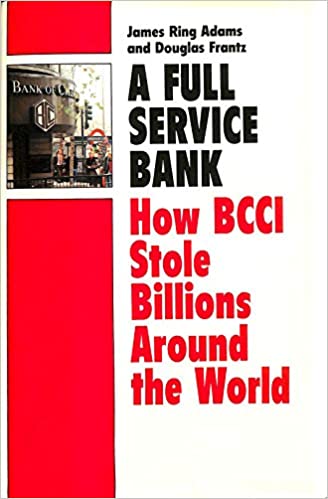
A Full Service Bank - How BCCI Stole Billions Around the World
A Full Service Bank - How BCCI Stole Billions Around the World, by journalists James Ring Adams and Douglas Frantz, was published in 1992, less than a year after the closure of the Bank of Credit and Commerce International (BCCI).
The authors undertook substantial research, drawing on previously unpublished BCCI documents, minutes of executive meetings, interviews, regulatory material and records relating to investigations in the United States. The book remains an important contemporary account of the allegations surrounding BCCI.
Its subtitle, however - “How BCCI Stole Billions Around the World” - presents a conclusion that is misleading and deserves closer examination.
The book documents serious losses, false accounting, concealed liabilities, excessive lending, questionable transactions, secret ownership arrangements and other misconduct. But it does not demonstrate that billions of dollars were simply siphoned out of BCCI by its senior management for their own personal enrichment.
That distinction is important.
Much of the money discussed in the book was connected with large loans that later became problematic, the concealment of losses, support for borrowers, transactions intended to maintain BCCI’s reported financial position, and the acquisition or financing of assets - including banking interests in the United States that themselves had value even after BCCI was closed.
Improper or unlawful accounting and transactions remain wrongdoing. But describing all such amounts as money that BCCI “stole” can give a different impression from what actually happened to the funds.
The question therefore is not whether BCCI suffered serious financial and management failures. It did.
The more precise questions that the authors did not establish:
How much money was genuinely stolen or misappropriated? How much represented losses on lending? How much was concealed through false accounting? How much remained represented by assets or investments? And how much, if any, was diverted for the personal enrichment of those running the Bank?
These distinctions are especially important when assessing the motives of senior management and the later portrayal of BCCI as a bank created principally for criminal enrichment.
The book also gives comparatively limited attention to the alternative being pursued immediately before BCCI’s closure.
By 1990-1991, Abu Dhabi had become BCCI’s majority shareholder. The shareholders included members of Abu Dhabi’s ruling family and had committed very substantial financial support to address the Bank’s losses and support a restructuring programme being developed with regulators.
That programme contemplated new management, substantial additional capital, the separation of viable banking operations from problem assets and the establishment of separately regulated successor banks.
BCCI was therefore not simply left without financial backing when regulators acted in July 1991. It was still operating, and its majority shareholder was continuing to provide support while restructuring discussions remained active.
The book does not properly explore why the restructuring alternative, which had been agreed in principle by the Bank of England, was brought to an abrupt end. Nor does it adequately examine why the Bank of England based its decision to close BCCI on a draft Section 41 report produced only days earlier by Price Waterhouse and never finalised.
The central question is not whether serious concerns existed. These had already been identified and were being addressed by BCCI and its Abu Dhabi majority shareholders through the restructuring programme. The question is what changed in those final days that made restructuring suddenly unacceptable and closure the preferred course.
If the reader begins with the title How BCCI Stole Billions Around the World, BCCI’s story can appear straightforward: billions were stolen, the Bank collapsed, and closure inevitably followed.
The historical record is more complicated.
BCCI suffered enormous losses and serious misconduct occurred. But the evidence also raises separate questions about where the billions actually went, whether those losses amounted to personal theft, what assets remained, what financial support Abu Dhabi was prepared to provide, and why the restructuring intended to protect depositors and preserve viable operations was not allowed to proceed by the Bank of England.
The book should therefore be read as an important investigative account of the allegations against BCCI - but not as the final answer to what the phrase “stole billions” actually means.
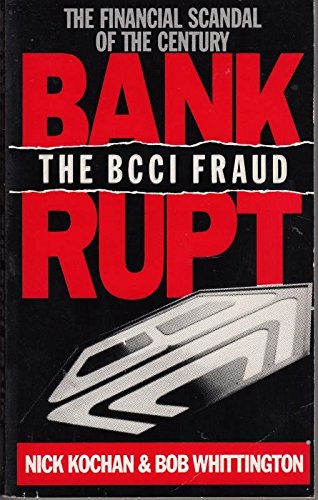
Bankrupt - The BCCI Fraud, by London journalists Nick Kochan and Bob Whittington, was published in November 1991, only a few months after the Bank of Credit and Commerce International (BCCI) was abruptly closed on 5 July 1991 through coordinated regulatory action led by the Bank of England.
The speed of publication is important. The book appeared before the Bingham Inquiry had reported, before the principal allegations had been examined through the later inquiries and court proceedings, and long before the outcome of BCCI’s liquidation could provide a fuller picture of its assets and liabilities.
Yet its title and presentation offered readers what appeared to be an already settled verdict: Bankrupt - The BCCI Fraud: The Financial Scandal of the Century.
The language was equally sweeping. BCCI was presented as the largest fraud in history and described as a haven for terrorists, arms dealers, drug-money launderers, intelligence services and dictators. The book also suggested that BCCI had “purported” to offer Muslim banking.
These descriptions deserve closer scrutiny.
The title Bankrupt could readily give a reader the impression that BCCI had simply collapsed because it was unable to meet its obligations to depositors and other creditors. But BCCI did not cease operating because it had run out of cash and closed its own doors. It was closed by regulatory action while still operating and while its Abu Dhabi majority shareholders were providing substantial financial support and pursuing a major restructuring.
Indeed, the book itself records continuing Abu Dhabi support and the subsequent High Court decision to allow further time for restructuring possibilities to be considered.
The authors identify serious losses, false accounting, concealed liabilities, problem lending and misconduct within parts of BCCI. Those matters cannot be dismissed. But the book frequently moves from allegations concerning particular executives, customers, accounts or transactions to sweeping descriptions of the Bank as a whole.
That distinction matters.
BCCI had a presence in 73 countries, employed thousands of people and served more than a million customers. A finding of wrongdoing involving particular executives or operations does not automatically establish that the entire worldwide Bank was fraudulent or operated with a universal criminal purpose.
The book was also written at a time when many of the most important questions remained unresolved. The Price Waterhouse Section 41 report on which the closure decision substantially relied was still a draft. Lord Justice Bingham had not yet conducted his inquiry into the Bank of England’s supervision of BCCI. Abu Dhabi’s restructuring proposals had been agreed in principle and fully examined publicly, and the later evidence concerning collections from BCCI’s assets and payments totalling over 90 % to most creditors was not yet available.
The book therefore provides a valuable contemporary account of the allegations and atmosphere immediately surrounding BCCI’s closure, but it should also be read as a product of that moment.
Its title, chapter headings and language frequently present allegations and interpretations with a degree of certainty that later readers may wish to test against the fuller documentary record.
Most importantly, Bankrupt does not establish simply by its title that BCCI was a bank incapable of meeting its obligations and destined inevitably for collapse. Nor does the accumulation of serious allegations by itself demonstrate that wrongdoing permeated every part of BCCI’s worldwide operations.
The historical questions are therefore wider than those suggested by the book’s title:
Was BCCI simply a bankrupt fraudulent bank that inevitably collapsed - or was it a troubled but still operating bank, supported by its majority shareholder and undergoing restructuring, that was closed before the alternatives had been allowed to proceed?
There is also a question about the remarkable speed with which the book appeared. Published only a few months after BCCI’s closure, before the Bingham Inquiry had reported and while many of the key allegations remained untested, was the priority to provide a carefully established historical account - or to be among the first to publish a dramatic account of what had already become one of the world’s biggest banking stories?
That question does not establish a commercial motive. But the timing, sensational title and sweeping language make it reasonable for later readers to consider whether the pressure to publish quickly, while public interest was at its height, came at the expense of a more measured assessment of the evidence.