
These books show how major Western banks laundered trillions of dollars in dirty money for cartels and corrupt elites. The investigations expose a massive double standard: while a smaller, non-Western bank like BCCI was instantly shut down, these giant banks were let off with fine-only penalties, allowing them to profit from financial crime without any threat of closure or imprisonment.
Black Edge: Insider Information, Dirt Money, and the Quest to Bring Down the Most Wanted Man in Wall Street (2017)
Black Edge: Insider Information, Dirt Money, and the Quest to Bring Down the Most Wanted Man in Wall Street by Sheelah Kolhatkar delivers a gripping investigative account that reveals how illegal, dirty money is generated at the very center of the Western financial system through deliberate market deception. The book focuses on the multi-billion-dollar hedge fund SAC Capital, run by Steven A. Cohen, one of the most powerful figures on New York's Wall Street. Kolhatkar reveals how the firm manufactured massive amounts of illicit wealth using a practice known as "black edge"-obtaining hidden, insider information to make highly profitable stock market trades before the general public knew what was happening.
The book details how a ruthless corporate culture actively encouraged employees to hunt for this hidden data to maximise firm profits and secure multi-million-pound executive bonuses. Kolhatkar shows that when the US government launched a massive investigation into this widespread fraud and illegal wealth creation, prosecutors ran into a wall of protection surrounding the top leadership. While several lower-level traders were convicted, the justice system pulled its punches against the man at the very top. Instead of facing prison for generating millions in dirty money, Cohen used his immense wealth to shield himself, settling the case with lenient corporate deals paid out of the firm's vast accounts, leaving his personal wealth completely intact.
Comparison with BCCI: The Protection of Management and Infrastructure
Black Edge provides direct evidence of the deep imbalance in financial enforcement, showing how Wall Street operations settle central wrongdoing through corporate wealth while non-Western structures face intense criminalisation.
-
The Scale of Money Laundering and Fines: Kolhatkar documents how prominent Western banking groups have handled vast sums of illicit money for drug cartels, corrupt officials and other criminals. In one of the best-known cases, around $378 billion passed through Wachovia’s accounts from Mexican currency exchanges without adequate anti-laundering checks. In 2012, HSBC admitted that its weak controls had allowed hundreds of millions of dollars in Mexican drug-cartel money to pass through its accounts.
-
How These Banks Were Treated: In each case, the banks were allowed to settle. They paid corporate penalties, accepted monitoring and continued trading. Penalties that sound large in isolation were modest compared with the banks’ size and profits. No bank was closed, and the institutions themselves were not branded criminal enterprises.
-
The Contrast with BCCI: The alleged money-laundering case that first damaged BCCI’s international standing involved a far smaller In the Tampa case, BCCI forfeited $14.8 million, matching the sum laundered through the bank in a US undercover operation. Western banks were penalised on a similar basis: Wachovia forfeited $110 million in identified drug proceeds. But the volumes involved were in a different league. Around $378 billion passed through Wachovia without adequate checks. At HSBC, more than $670 billion in transfers from its Mexican arm went largely unmonitored. Against those sums, the penalties were small, and both banks carried on trading with their reputations largely intact. BCCI’s case involved a fraction of those amounts. Yet it became the defining image of the bank well before its closure in 1991, and the label “money launderer” has stayed with BCCI ever since. The question this book raises is whether a $14.8 million case permanently defined one bank because of its association with the Third World, while failures involving hundreds of billions of dollars became, for Western banks, a passing episode settled by fines.
Too Big To Jail: How Prosecutors Compromised with Silicon Valley and Wall Street (2014)
Too Big To Jail: How Prosecutors Compromised with Silicon Valley and Wall Street by law professor Brandon L. Garrett analyses how the American justice system deals with corporate crime. He shows how federal prosecutors, faced with very large companies, have increasingly avoided taking them to trial. His study covers hundreds of corporate prosecutions, with particular attention to major banks such as HSBC, JPMorgan Chase, Credit Suisse and Wachovia.
Garrett describes how the US Department of Justice came to rely on negotiated settlements, especially deferred prosecution and non-prosecution agreements, while individual executives were rarely charged. He highlights money laundering and sanctions breaches as leading examples. HSBC and Wachovia (now part of Wells Fargo) were found to have handled money linked to Mexican drug cartels. Other banks, including Credit Suisse, were found to have processed payments for sanctioned countries. Yet none of these banks was shut down. They were allowed to settle by paying penalties and accepting monitors. Critics argue this turned serious wrongdoing into a cost of doing business: the banks stayed open, and senior executives largely escaped personal prosecution.
Comparison with BCCI: The Money Laundering and Enforcement Double Standard
Garrett’s findings offer a useful lens on BCCI’s case. They show how failings that came to define a bank from the developing world were, at Western banks, dealt with through negotiated settlements.
1. The Scale of Money Laundering by Western Banks
HSBC admitted in 2012 that at least $881 million in drug-cartel money had passed through its accounts. More than $670 billion in transfers from its Mexican arm went largely unmonitored. At Wachovia, now part of Wells Fargo, around $378 billion from Mexican currency exchanges passed through without adequate checks. Other banks, including Credit Suisse, were found to have processed payments for sanctioned countries.
2. How These Banks Were Treated
Once their failings came to light, these banks negotiated with prosecutors and regulators. They agreed reforms, accepted independent monitors and continued trading under deferred prosecution agreements. HSBC’s $1.9 billion settlement was widely reported as equal to only a few weeks’ profit, and Wachovia settled for $160 million. The wrongdoing was separated from the survival of the bank: the institutions continued, and their senior executives generally avoided criminal charges.
3. The Contrast with BCCI
BCCI’s money-laundering case came from a two-year US Customs undercover operation in Tampa, Operation C-Chase. It was led by a single undercover agent posing as a businessman laundering drug money, who drew a small number of branch officers into transactions. The bank pleaded guilty in 1990 and forfeited $14.8 million, matching the sum laundered through it in the operation. The officers convicted were branch-level and middle managers. Senior management was not charged in that case. The comparatively small Tampa case nevertheless became the defining image of BCCI well before its closure in 1991. The label “money launderer” has stayed with the bank ever since. The question this raises is whether a $14.8 million case permanently defined one bank because of its association with the Third World, while failures involving hundreds of billions of dollars became, for Western banks, a passing episode settled by fines.
Too Big to Jail: Inside HSBC, the Mexican Drug Cartels and the Greatest Banking Scandal of the Century
Too Big to Jail, published in 2022, and written by British journalist and former Independent editor Chris Blackhurst, delivers a fierce investigative exposé of the LIBOR scandal, documenting how an elite network of global bankers, traders, and brokers systematically manipulated the world’s key benchmark interest rate for years.
The narrative strips back the mechanism of a fraud that dictated how money was borrowed and lent globally, dictating the pricing on hundreds of trillions of dollars in financial contracts, mortgages, student loans, and municipal bonds. Bankers colluded via chat rooms, phone calls, and informal favors to artificially inflate or deflate rates to maximise their trading positions or to make their banks appear healthier than they were during the 2008 financial crisis. Blackhurst details an unregulated "honor system" culture among young traders that was actively enabled by senior executives, who intentionally looked the other way while cashing in on massive corporate bonuses. The text highlights these corrupt practices across major global powerhouses - including Barclays Capital, UBS, Rabobank, and Citigroup - demonstrating that while elite traders and bank executives profited, the manipulation inflicted an estimated $1 trillion cost on ordinary savers, students, homeowners, and local governments like Philadelphia and Oakland. Ultimately, the book serves as a sharp critique of central bankers and financial regulators who routinely missed, ignored, or brushed aside early warnings and blatant evidence of widespread rate-rigging.
Comparison with BCCI
Too Big to Jail offers a direct, modern case study of the structural double standard at the heart of global banking enforcement. When BCCI faced governance and compliance failures in 1991, Western regulators orchestrated a terminal, coordinated shutdown, completely abandoning an agreed-upon restructuring programme. Yet, when Western financial giants like Barclays, UBS, and Citigroup systematically rigged a benchmark that stripped $1 trillion from everyday citizens and local municipalities, they were deemed "too big to jail." Rather than facing institutional liquidation or criminal prosecutions for senior leadership, these banks were granted regulatory paths to survival, treating a multi-trillion-dollar fraud as a mere compliance speedbump. This stark contrast reinforces the central argument of a forthcoming book - Verdict Deferred: global banking regulation does not penalise fraud equally, but is instead weaponised to destroy non-Western institutions while protecting the systemic survival of the Western financial elite.
Dark Towers: Deutsche Bank, Donald Trump, and an Epic Trail of Destruction
Deutsche Bank, Donald Trump, and an Epic Trail of Destruction, published in 2020 provides an investigative history of the decades of controversy surrounding Deutsche Bank as it transformed into a major global investment bank. The book describes repeated episodes involving aggressive corporate expansion, deep regulatory failures, highly questionable clients, market misconduct, and severe weaknesses in internal controls. Enrich examines the bank’s relationships with prominent customer accounts, detailing a corporate culture that placed extraordinary emphasis on rapid growth and profits above basic honesty. The book reveals a history where serious controversies accumulated over many years, yet Deutsche Bank remained a major international bank. Instead of treating every scandal as proof that the entire bank had ceased to be a legitimate banking business, regulators chose to impose financial penalties, require operational improvements, and pursue particular misconduct while keeping the bank open.
Comparison with BCCI
For comparison with BCCI, Dark Towers demonstrates how differently a major bank can be evaluated and treated even when it carries a long record of serious controversies. Books published immediately following BCCI’s closure in 1991 frequently used sensational expressions like "criminal enterprise," "world's sleaziest bank," and "world's most corrupt financial empire," using serious misconduct involving specific individuals to characterize the worldwide bank as a whole and justify its terminal liquidation. Enrich's narrative shows that when a Western-aligned giant commits similar multi-layered offenses, the legal system separates individual wrongdoing from the continuing existence of the bank as a whole. Rather than destroying the entity, authorities handle the fraud through corporate fines-costs that are simply generated from ongoing customer business - allowing the bank to survive while senior executives avoid imprisonment.

Beskidte Milliarder: Da Danske Bank blev centrum i verdens største hvidvasksag
Dirty Billions: When Danske Bank Became the Centre of the World’s Biggest Money-Laundering Case
Beskidte milliarder, published in 2019 and written by Simon Bendtsen, Eva Jung, and Michael Lund, exposes the massive money-laundering scandal at Danske Bank’s Estonian branch, tracing how Europe’s largest bank became a conduit for trillions of kroner in suspicious wealth. Written by three investigative journalists from the Danish newspaper Berlingske, the book details how Denmark's largest bank welcomed highly profitable but suspicious non-resident customers to its Estonian operation. Despite a series of internal and external compliance warnings, senior management continuously ignored the red flags to protect their revenues. The authors spent two years investigating the affair, showing how the eventual public exposure shook the bank, ruined its global reputation, and forced the departure of top leaders. Yet, despite the staggering scale of the illicit money movement, Danske Bank as a whole remained open and operational.
Comparison with BCCI
Beskidte milliarder provides a direct example of how modern regulators protect a major European banking business even when it is caught in one of the largest money-laundering operations in history. Following its closure in 1991, BCCI's localised compliance failures were used to characterize the entire global bank as a "criminal enterprise," leading to an immediate shutdown that wiped out the legitimate business of hundreds of international branches. In stark contrast, when Danske Bank was exposed, regulators separated the criminal activities of the Estonian operations from the identity of the bank as a whole. Rather than enforcing terminal liquidation, authorities focused their penalties on the offending business and internal controls. The bank settled its liabilities through corporate fines - costs that were simply generated from ongoing customer business - allowing the financial institution to survive while senior executives avoided imprisonment. While the book is currently principally available in Danish, its subject makes it a highly valuable comparative reference for the library.
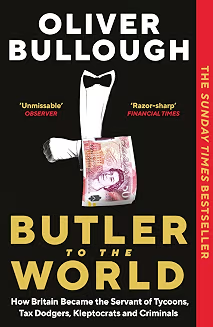
Butler to the World: How Britain Became the Servant of Tycoons, Tax Dodgers, Kleptocrats and Criminals
Butler to the World: How Britain Helps the World's Worst People Launder Money, Commit Crimes, and Get Away with It, published in 2022 and written by Oliver Bullough, examines the specialised role developed by Great Britain and its linked offshore networks in handling the wealth of oligarchs, kleptocrats, and tax avoiders. Rather than focusing on a single institution, Bullough delivers a sweeping analysis of how British banks, elite lawyers, accountants, company formation agents, and high-end property markets work together to move, protect, and legitimise international wealth. The book’s core argument is that the United Kingdom deliberately built a highly lucrative global industry providing butler-like services to wealthy international clients, including many whose money directly originated in state corruption or organized crime.
Comparison with BCCI
Butler to the World places the bank’s historic client relationships within a much wider international system, dismantling the narrative that its operations were uniquely suspicious. Following its closure in 1991, sensationalised accounts frequently pointed to BCCI's relationships with powerful politicians, controversial governments, and wealthy clients from politically unstable countries as unique proof of a criminal corporate identity. Bullough's research proves that servicing politically exposed individuals, managing overseas wealth, and curating opaque offshore structures have never been practices confined to banks originating in the developing world. Instead, this exact business model has been actively institutionalized and protected inside the West's most established financial centers. While this context does not excuse any unlawful activity, it reveals a profound double standard: conduct that was used to brand BCCI a unique "criminal empire" and justify its forced liquidation forms the everyday, profitable infrastructure of the modern Western banking system - where institutions survive on customer-funded fines and senior executives avoid imprisonment.