
These books detail the boardroom decisions behind the 2008 Wall Street crash, which was driven by predatory lending and the sale of high-risk debt to maximise corporate profits and executive bonuses. They highlight the blatant double standard of the "too big to fail" doctrine, illustrating how central banks refused to close these institutions and instead intervened to rescue the major Western banks that had brought the global financial system to the brink of collapse.

The Big Short: Inside the Doomsday Machine
The Big Short: Inside the Doomsday Machine. published in 2011 and written by Michael Lewis, provides a harrowing a post-examination of the reckless subprime mortgage trading and credit bubble collapse across Wall Street that triggered the 2008 global financial crisis.
The narrative features global investment giants- including Deutsche Bank, Morgan Stanley, Bear Stearns, and Goldman Sachs - detailing how these institutions engineered, packaged, and aggressively sold toxic Collateralised Debt Obligations (CDOs). To illustrate the terrifying scale of this unchecked risk, the author highlights how Morgan Stanley was brought to the brink of total collapse by a single trader's hidden $9 billion subprime transaction.
The book also exposes how Wall Street intentionally transformed risky subprime mortgages into highly profitable, dangerously opaque financial products, deliberately obscuring their complexity and risks from investors to prioritise short-term profit. This systemic deception was actively enabled by credit rating agencies, which prioritised corporate revenue over analytical accuracy by rubber-stamping fundamentally flawed securities with AAA ratings. Ultimately, the author delivers a severe critique of a failed regulatory environment that refused to curb excessive leverage and deceptive practices, allowing systemic risks to accumulate unchecked until the entire global financial architecture came to the brinck of collapse.
Comparison with BCCI
The Big Short provides a crucial minimum point for understanding the double standard in global banking enforcement. While the 2008 crisis exposed Wall Street institutions operating on a foundation of structural deception and complex financial products that concealed serious risks, these Western banks were deemed "too big to fail" and systematically bailed out by Western regulators. Contrasting the continued operations of these major banks with the absolute, coordinated removal of BCCI in 1991 reveals a profound regulatory unequal treatment: one where Western structural fraud is managed and subsidised, while non-Western institutional crises are swiftly met with forced liquidation.
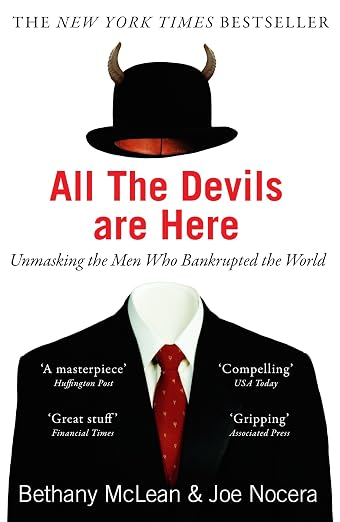
All the Devils Are Here: Unmasking the Men Who Bankrupted the World
All the Devils Are Here: Unmasking the Men Who Bankrupted the World, published in 2011 and written by Bethany McLean and Joe Nocera, records how a wide network of actors including bank CEOs, politicians, deceptive lenders, and Wall Street traders - collectively caused the 2008 financial crisis. The book focuses on major banks and lenders like Citigroup, Merrill Lynch, Goldman Sachs, and Countrywide Financial. The authors detail how Citigroup and Merrill Lynch loaded their own balance sheets with highly risky subprime debt just to earn short-term fees, while Countrywide acted as the primary engine supplying deceptive loans carrying hight risk and interest rates to Wall Street. Meanwhile, financial giants like Goldman Sachs and the insurance company AIG played hidden roles in spreading the risk. McLean and Nocera argue that the blame does not belong to a single group; instead, "many devils" helped bring hell to the economy. Senior bank executives intentionally ignored the massive risks of these flawed financial products because the system allowed them to pocket immense personal bonuses before the entire system collapsed.
Comparison with BCCI
All the Devils Are Here provides a powerful look at how Western regulators use double standards to protect their own banks. When BCCI faced compliance and governance problems in 1991, Western regulators led by the Bank of England abruptly closed it down, completely ignoring a rescue plan that had already been agreed upon. Yet, when Western banks like Citigroup, Merrill Lynch, and Goldman Sachs built an entire system based on deceptive lending and high risk debts debt hurting millions of ordinary people - they were not destroyed. Instead of liquidating these corrupt entities, governments and central banks bailed them out and kept them running. This contrast proves that the global banking system does not punish fraud equally; instead, it handles Western institutional deception as an operational problem, allowing these banks to treat criminal behaviour as an ongoing operational expense paid for with corporate fines - costs that were simply generated from ongoing customer business - ensuring that the selected financial institutions survived while senior executives avoided imprisonment.
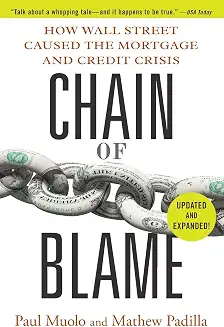
Chain of Blame: How Wall Street Caused the Mortgage Meltdown
Chain of Blame: How Wall Street Caused the Mortgage Meltdown, published in 2008 and written by Paul Muolo and Mathew Padilla, investigates the direct connection between aggressive street-level mortgage lenders and the major Wall Street banks that funded them. The book focuses heavily on financial institutions like Bear Stearns, Lehman Brothers, and Washington Mutual (WaMu). The authors reveal how these traditionally trusted banks eagerly poured money into the housing market, packaged unstable subprime mortgages into financial products, and intentionally ignored declining lending standards to maximise short-term profits and executive bonuses. When the subprime empire crashed in 2007, an average of fifty lenders went bankrupt every month. Chain of Blame details how a massive web of players - including bank executives, credit rating agencies, underwriters, and unregulated brokers - became entangled in a system driven purely by greed, creating a disaster where many were responsible but almost no one was willing to admit their mistakes.
For Comparison with BCCI
Chain of Blame highlights a deep double standard in how regulators react to systemic financial failure. When BCCI faced compliance failures and a complex corporate structure, Western regulators led by the Bank of England used these issues as an excuse to execute a sudden, forced shutdown, completely refusing to let the bank restructure or rescue its operations. However, when the entire Western housing market crashed due to widespread fraud and reckless behaviour by banks like Bear Stearns and Lehman Brothers, the regulatory response was entirely different. Instead of treating the broken system as a reason to ban offshore finance or shut down the entire network, Western governments worked to isolate the damage, bail out the surviving institutions, and protect the wider Western financial system. This contrast proves that the global banking system handles Western institutional deception as an operational problem, allowing these banks to treat criminal behaviour as an ongoing operational expense paid for with corporate fines - costs that were simply generated from ongoing customer business - ensuring that the financial institutions survived while senior executives avoided imprisonment.
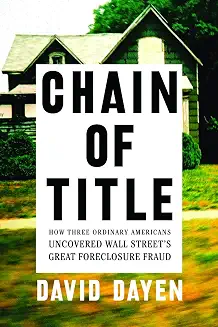
Chain of Title: How Three Ordinary Americans Uncovered Wall Street's Great Foreclosure Fraud
Chain of Title: How Three Ordinary Americans Uncovered Wall Street's Great Foreclosure Fraud, published in 2016 and written by David Dayen, exposes the post-crash "robo-signing" scandal, revealing how America's largest retail banks systematically used fake, backdated, and forged documents to illegally foreclose on millions of homes. The book focuses on US retail banking giants like Bank of America, JPMorgan Chase, Wells Fargo, and Citigroup. Dayen tells the true story of three ordinary people in Florida, USA - a cancer nurse, a car dealership worker, and an insurance fraud specialist - who were facing repossession of their homes. By closely reading their legal paperwork, they discovered that mortgage companies and banks were massively fabricating, backdating, and counterfeiting legal titles because they had lost track of who actually owned the loans during the housing bubble. This "robo-signing" mess became the largest consumer crime in American history, implicating top bank executives who intentionally ignored the fraud to clear their books quickly and protect their profits.
Comparison with BCCI
Chain of Title highlights a shocking double standard in how the law treats institutional lawbreaking. When BCCI faced compliance failures and financial gaps in 1991, Western regulators led by the Bank of England claimed that its unverified accounting made it a criminal enterprise, using this to abruptly shutdown BCCI that bypassed all opportunities for a structured rescue. Yet, when major Western banks systematically forged millions of legal court documents, committed widespread perjury, and illegally seized private property from ordinary citizens, regulators did not close them down. Instead, the government protected these banks, allowing them to treat massive consumer crimes as a simple administrative risk. The banks settled their liabilities through corporate fines - costs that were simply generated from ongoing customer business - ensuring that the financial institutions survived while senior executives avoided imprisonment.
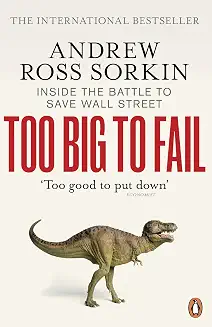
Too Big to Fail: Inside the Battle to Save Wall Street 2010
Too Big to Fail: Inside the Battle to Save Wall Street, published in 2010 and written by Andrew Ross Sorkin, delivers a dramatic, boardroom-by-boardroom account of elite bank executives scrambling to save their banks as the subprime mortgage fraud collapsed suddenly.. Focusing on major New York Wall Street players like Lehman Brothers, Bear Stearns, Merrill Lynch, Goldman Sachs, and the insurance giant AIG, Sorkin reconstructs the frantic phone calls and behind-the-scenes panic that shaped the 2008 financial crisis. The book details how the banks became trapped by their own greed after converting pools of residential mortgages into highly complex and risky investment products known as Collateralised Debt Obligations (CDOs). When the housing bubble burst, these multi-billion-dollar institutions faced instant collapse. Sorkin charts the desperate actions of top executives, like Lehman Brothers CEO Dick Fuld, alongside government officials as they engineered emergency bailouts and forced acquisitions, such as Bank of America buying Merrill Lynch and JPMorgan Chase absorbing Bear Stearns, to prevent a total collapse of the global financial system.
Comparison with BCCI
Too Big to Fail exposes the ultimate double standard in how global bank regulators handle systemic crises. When BCCI faced financial and compliance issues in 1991, Western authorities refused to consider a restructuring plan that had already been agreed upon with its majority shareholders in Abu Dhabi, opting instead for a sudden, forced shutdown and terminal liquidation. However, Sorkin’s account shows that when major Western banks brought the entire global economy to its knees through systemic fraud and reckless risk-taking, the regulatory response was completely different. Instead of closing down these complicit institutions, the US Treasury and central banks worked around the clock to insulate, subsidise, and rescue them. This honest look at Wall Street's survival reinforces how Western institutional deception is treated as an operational problem, allowing these banks to handle their liabilities through customer-funded corporate fines - costs generated directly from ongoing customer business - ensuring that the financial institutions survived while senior executives avoided imprisonment.
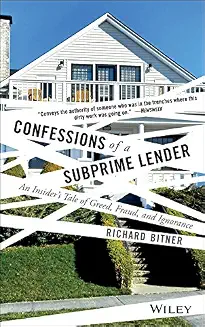
Confessions of a Subprime Lender
Confessions of a Subprime Lender: An Insider's Tale of Greed, Fraud, and Ignorance, published in 2008, provides a ground-level revelation of how large institutional wholesale banks incentivised independent brokers to manipulate loan applications and push high-risk predatory loans. As a co-founder of a booming subprime mortgage company, Bitner watched the industry spiral out of control as skyrocketing house prices sparked widespread greed. He reveals a shocking reality: nearly three out of every four subprime mortgages were built on misleading or fraudulent data, where brokers routinely falsified borrower incomes to turn unqualified applicants into "qualified" buyers. While unscrupulous brokers tricked gullible families on Main Street, Bitner puts the ultimate blame on Wall Street investment banks and credit rating agencies. These massive institutions greedily bought up these risky loans, ignored the obvious fraud, and packaged them into unstable financial products to secure massive fees and executive bonuses before the entire market collapsed under a mountain of bad debt.
Comparison with BCCI
Confessions of a Subprime Lender reveals the open hypocrisy in how Western regulators define a "criminal bank." When BCCI faced compliance failures and financial gaps in 1991, international authorities claimed its loose accounting and unconventional lending methods made it too dangerous to exist, using this as an excuse to execute a sudden, forced shutdown. Yet, Bitner's insider account proves that the entire domestic US mortgage system was operating as a massive, coordinated fraud machine where falsifying documents and inventing fake assets was the standard business model. Instead of treating these complicit Western wholesale banks as criminal syndicates and dismantling them, regulators stepped in to protect their operations. The banks settled their liabilities through corporate fines costs that were simply generated from ongoing customer business - ensuring that the financial systems survived while senior executives avoided imprisonment. This extreme double standard shows that global banking enforcement is entirely political: non-Western banks face forced liquidation for compliance failures, while Western banks are systematically insulated even when their entire business relies on systemic deception