
These studies, legal reviews, and institutional histories examine how Western regulatory and prosecutorial frameworks handle systemic financial crime. They highlight how authorities frequently reclassify major offences as administrative infractions, penalising Western banks with corporate fines rather than shutting them down and holding senior executives criminally accountable.
Crashed: How a Decade of Financial Crises and Central Bank Intervention Changed the World (2018)
Crashed: How a Decade of Financial Crises and Central Bank Intervention Changed the World by economic historian Adam Tooze provides a sweeping, international analysis of the 2008 financial crisis and its long-term geopolitical consequences. Tooze moves past simple local descriptions to explain how high-risk, abusive mortgage lending deeply bound Wall Street to European financial centres, creating a borderless financial contagion. The text traces the massive, coordinated emergency measures taken by global central banks. Most notably, it examines the US Federal Reserve's injection of trillions of dollars into domestic and foreign banks using emergency currency swap lines to keep them afloat. Tooze demonstrates that this post-crisis response transformed central banks into permanent market backstops. This intervention fundamentally re-engineered the relationship between states and private financial corporations to guarantee the survival of the Western banking hierarchy.
Comparison with BCCI: Geopolitical Protection and the Reorganisation Double Standard
Crashed highlights the vast structural and geopolitical double standards embedded within global financial governance, proving that institutional survival is heavily dictated by geographic origin.
- Standard Local Operations vs. Interconnected Deception: Tooze’s extensive research proves that massive, hidden risks and extreme corporate complexity are entirely routine features across the Western financial system. Yet, when major European and American banks brought the global economy to the edge of ruin to maximise corporate profits, international regulators completely rewrote the rules of finance to protect them. In sharp contrast, BCCI was founded by Agha Hasan Abedi out of a genuine desire to serve and support developing countries that were historically ignored by colonial-era Western banks. BCCI's local operations were standard retail banks providing vital trade finance to ordinary businesses in the Global South, and there is no evidence it was established as a criminal organisation.
- The Reorganisation Double Standard: Tooze documents how central banks and Western governments rewrote regulatory frameworks, absorbed trillions in losses, and allowed failing Western institutions to reform through corporate fines while shielding senior executives from prison. Conversely, when BCCI ran into financial difficulties, Western regulators completely rejected a fully funded, financially backed restructuring plan. This reorganisation framework was specifically designed by majority shareholders to recapitalise the bank and protect its millions of commercial depositors, yet authorities deliberately chose a sudden, forced liquidation over a managed rescue.
-
The Critical Centre-Branch Divide: The ultimate link between the two cases highlights a profound inequality in global regulation. For the Western banking giants featured in Tooze's account, regulators actively protected their global infrastructures, separating the extreme failures of central management from the day-to-day operations of their branch networks. However, when BCCI faced central accounting difficulties, a strict centre-branch divide was completely ignored by regulators. Instead of treating the central bookkeeping issues as separate from the honest, day-to-day work of the local branches, Western authorities instantly used the core failures as an excuse to execute a sudden, global shutdown that destroyed the entire bank - proving that the ultimate fate of an institution depends entirely on its geographic origin and whether it is a Western bank from the home country.
The Chickenshit Club: Why the Justice Department Fails to Prosecute Executives (2017)
The Chickenshit Club: Why the Justice Department Fails to Prosecute Executives, by Jesse Eisinger, delivers a highly critical investigative account of corporate greed, executive freedom from punishment, and the weak response from the United States Department of Justice (DOJ). The book explores a central, surprising question: why were no top bankers put in prison after the 2008 financial crash? Eisinger traces the history of US federal white-collar prosecution from the 1970s -when prosecutors successfully put corporate leaders in prison - before a major change occurred during the early 2000s.
He reveals how massive political pressure from the big banks, a fear of losing in court, and a changing mindset within government departments made prosecutors unwilling to take top executives to trial. Instead of holding individual bosses legally responsible, the authorities began relying on lenient corporate deals and soft out-of-court agreements. This change effectively allowed top chief executives at giant institutions like Lehman Brothers, Countrywide, and Goldman Sachs to commit massive financial wrongs with no personal consequences. Eisinger uses the scandals at these major American banking giants, alongside later trading failures at JPMorgan Chase and Citigroup, to illustrate how the justice system completely pulled its punches when confronting the most powerful financial institutions in New York.
Comparison with BCCI: The Inequality of Imprisonment
The Chickenshit Club exposes a clear double standard regarding when corporate wrongdoing results in actual imprisonment for senior managers, proving that justice is applied selectively based on an institution's origin.
-
Standard Local Operations vs. Mainstream Impunity: Eisinger’s work details a modern era where powerful Western executives are shielded by a timid justice system that reduces massive financial crimes to simple corporate fines paid with customer money. In sharp contrast, BCCI, founded by Agha Hasan Abedi. Provided banking services to serve and support developing countries that were historically ignored by colonial-era Western banks. BCCI's local operations across the globe were standard retail banks providing vital trade finance to ordinary businesses in the Global South, and there is no evidence it was established as a criminal organisation.
- The Reorganisation Double Standard: Eisinger documents how the Western legal apparatus creates soft, protective pathways like deferred prosecution agreements to keep failing Western institutions open and give their leaders a chance to reform. Conversely, when BCCI ran into financial difficulties, Western regulators completely rejected a fully funded, financially backed restructuring plan. This reorganisation framework was specifically designed by majority shareholders to recapitalise the bank and protect its millions of commercial depositors, yet authorities deliberately chose a sudden, forced liquidation over a managed rescue.
-
The Critical Centre-Branch Divide: The ultimate link between the two cases shows a deep inequality in how the system works in Western countries. The government creates soft, protective pathways- such as letting a bank pay a fine instead of going to trial- just to keep failing Western institutions open and give their bosses a chance to change. On the other hand, when BCCI ran into financial difficulties, Western regulators completely rejected a fully funded, financially backed restructuring plan. This reorganisation framework was specifically designed by majority shareholders to recapitalise the bank and protect its millions of commercial depositors, yet authorities deliberately chose a sudden, forced liquidation over a managed rescue.
-
The Critical Centre-Branch Divide: The ultimate link between the two cases highlights a profound inequality in global regulation. For the major American banking giants featured in Eisinger's book, the justice system separated the specific financial wrongs of central management from the continuity of the wider bank, allowing the institutions to survive while executives avoided prison. However, when BCCI faced central accounting difficulties, a strict centre-branch divide was completely ignored by regulators. Instead of treating the central bookkeeping issues as separate from the honest, day-to-day work of the local branches, Western authorities instantly used the core failures as an excuse to execute a sudden, global shutdown. Following this forced shutdown, the legal system completely bypassed lenient corporate deals in favour of extensive criminal prosecutions worldwide. Top executives and managers - including Chief Executive Swaleh Naqvi and London treasury head Syed Ziauddin Ali Akbar - were directly charged, convicted, and sentenced to long prison terms for fraud and false accounting. This clear and unmistakable contrast proves that the ultimate fate of both an institution and its leadership depends entirely on its geographic origin and whether it is a Western bank from the home country.
The End of Alchemy: Money, Banking, and the Future of the Global Economy (2015)
The End of Alchemy: Money, Banking, and the Future of the Global Economy by Mervin King, former Governor of the Bank of England, provides a powerful inside look at the fundamental defects or weaknesses built into the modern Western banking network. King argues that the entire global financial system relies on a form of economic "alchemy" - the dangerous false promise that risky, long-term investments can be instantly turned into safe, short-term cash for depositors. The book details how this unrealistic setup encourages major financial institutions to take on extreme risks to maximise corporate profits and boost short-term payouts.
King shows how the central banking establishment and government regulators completely failed to see the mounting dangers before the 2008 financial crash. He explains that when the crisis hit, the entire financial structure collapsed from within because banks lost trust and stopped lending money to one another. To prevent a total economic disaster, central banks were forced to step in as permanent market backstops, injecting trillions of pounds of public funds to rescue failing Western institutions and keep their systems running.
Comparison with BCCI: The Structural Illusion and the Reorganisation Double Standard
The End of Alchemy exposes the deep systemic hypocrisy of global banking regulation, demonstrating how the fundamental flaws of Western institutions are actively supported while non-Western competitors are demolished.
- Legitimate Customer Support vs. Financial Alchemy: King proves that mainstream Western banks operate on a highly unstable foundation of financial engineering and hidden risks designed to generate massive profits at the centre. In sharp contrast, BCCI was founded by Agha Hasan Abedi out of a genuine desire to serve and support developing countries that were historically ignored by colonial-era Western banks. BCCI's local operations across the globe were standard retail banks providing vital trade finance to ordinary businesses in the Global South, and there is no evidence it was established as a criminal organisation.
- The Reorganisation Double Standard: King’s analysis shows that when the central "alchemy" of the Western banking system failed in 2008, governments and central authorities instantly rewrote the rules of finance. They deployed unprecedented public capital and state lifelines to manage the fallout and keep these failing institutions open. Conversely, when BCCI ran into financial difficulties, Western regulators completely rejected a fully funded, financially backed restructuring plan. This reorganisation framework was specifically designed by majority shareholders to recapitalise the bank and protect its millions of commercial depositors, yet authorities deliberately chose a sudden, forced liquidation over a managed rescue.
-
The Critical Centre-Branch Divide: The ultimate link between the two cases highlights a profound inequality in global regulation. For the major British and Western giants that relied on dangerous financial alchemy, the regulatory system creates lenient, protective pathways like out-of-court deals to keep failing Western institutions open and give their bosses a chance to fix their mistakes. However, when BCCI faced central accounting difficulties, a strict centre-branch divide was completely ignored by regulators. Instead of treating the central bookkeeping issues as separate from the honest, day-to-day work of the local branches, Western authorities instantly used the core failures as an excuse to execute a sudden, global shutdown that destroyed the entire bank - proving that the ultimate fate of an institution depends entirely on its geographic origin and whether it is a Western bank from the home country.
Back from the Brink: 2008 and the Financial Crisis (2011)
Back from the Brink: 2008 and the Financial Crisis by Alistair Darling, the former UK Chancellor of the Exchequer, provides a firsthand insider account detailing the frantic decisions made to prevent the total collapse of the British banking system during the 2008 financial crisis. Darling reconstructs the intense behind-the-scenes negotiations, late-night phone calls, and widespread panic that gripped the British government and the City of London. The book chronicles how major banking giants like Northern Rock, the Royal Bank of Scotland (RBS), and HBOS collapsed from within when global banks completely stopped lending money to one another. Facing a catastrophic shutdown of the international financial markets, Darling and the British government were forced to carry out the largest state-funded rescues in modern UK history, injecting hundreds of billions of pounds of taxpayers' money to take over, subsidise, and buy massive controlling stakes in these failing Western banks to keep them open and running.
Comparison with BCCI: The Ultimate Reorganisation Double Standard
Back from the Brink exposes the raw political reality of the "too big to fail" doctrine, demonstrating how the state apparatus is re-engineered overnight to ensure the survival of Western establishment banks.
- Legitimate Customer Support vs. Debt-Fuelled Gambling: Darling proves that the 2008 crisis was driven by massive Western banking networks that brought the domestic economy to its knees through central corporate greed and high-risk lending practices. In sharp contrast, BCCI was founded by Agha Hasan Abedi out of a genuine desire to serve and support developing countries that were historically ignored by colonial-era Western banks. BCCI's local operations across the globe were completely standard retail banks providing vital trade finance to ordinary businesses in the Global South, and there is no evidence it was established as a criminal organisation.
- The Reorganisation Double Standard: Darling’s memoir details how the UK government deployed unprecedented public capital to ensure that failing Western banks could treat their massive balance sheet collapses as a temporary crisis to be managed. Conversely, when BCCI ran into financial difficulties, Western regulators completely rejected a fully funded, financially backed restructuring plan. This reorganisation framework was specifically designed by majority shareholders to recapitalise the bank and protect its millions of commercial depositors, yet authorities deliberately chose a sudden, forced liquidation over a managed rescue.
-
The Critical Centre-Branch Divide: The ultimate link between the two cases highlights a profound inequality in global regulation. For the Western giants featured in Darling's account, regulators actively protected their global infrastructures, separating the extreme failures of central management from the day-to-day operations of their branch networks. However, when BCCI faced central accounting difficulties, a strict centre-branch divide was completely ignored by regulators. Instead of treating the central bookkeeping issues as separate from the honest, day-to-day work of the local branches, Western authorities instantly used the core failures as an excuse to execute a sudden, global shutdown that destroyed the entire bank - proving that the ultimate fate of an institution depends entirely on its geographic origin and whether it is a Western bank from the home country.

Fraud in the Markets: Why It Happens and How to Fight It (2010)
Fraud in the Markets: Why It Happens and How to Fight It by Peter Goldmann, a leading expert in fraud detection, delivers a sobering look at how widespread deception and corruption directly triggered the 2008 global financial crash. Goldmann looks past the complex language of economics to reveal that the financial collapse was fundamentally driven by a culture of "anything goes" on New York's Wall Street. This reckless environment fuelled the creation of super-risky, highly complicated investment products that hid financial dangers from the public.
The book exposes the deeply dishonest lending practices that completely engulfed the American mortgage industry, alongside the brazenly deceptive marketing used to sell these unstable products to unsuspecting investors. Goldmann details the legally questionable conduct of top executives at giant firms like Lehman Brothers, Countrywide, and Washington Mutual right before they collapsed. He highlights a massive systemic failure where the financial services industry became a breeding ground for dark corporate crimes, leaving an economy on the brink of ruin while many of the main perpetrators walked away completely unpunished.
Comparison with BCCI: The Protection of New York Corporate Corruption
Fraud in the Markets uncovers the profound double standards of financial enforcement, showing how institutional fraud is tolerated within the Western establishment while non-Western banks are entirely liquidated.
- Standard Local Operations vs. Mainstream Dishonesty: Goldmann proves that the 2008 crisis was born from systemic, widespread fraud engineered at the very heart of the Western financial system to maximise corporate profits and executive bonuses. In sharp contrast, BCCI was founded by Agha Hasan Abedi out of a genuine desire to serve and support developing countries that were historically ignored by colonial-era Western banks. BCCI's local operations across the globe were standard retail banks providing vital trade finance to ordinary businesses in the Global South, and there is no evidence it was established as a criminal organisation.
- The Reorganisation Double Standard: Goldmann documents a perfect storm of financial market corruption where major Western firms engaged in egregiously deceptive practices yet were insulated from terminal destruction. When these high-risk operations collapsed from within, Western governments and central authorities stepped in to manage the fallout, rewriting regulatory rules and deploying trillions in public funds to keep the wider banking architecture open. Conversely, when BCCI ran into financial difficulties, Western regulators completely rejected a fully funded, financially backed restructuring plan. This reorganisation framework was specifically designed by majority shareholders to recapitalise the bank and protect its millions of commercial depositors, choosing a sudden, forced liquidation over a managed rescue.
- The Critical Centre-Branch Divide: The ultimate link between the two cases highlights a profound inequality in global regulation. The New York Wall Street giants featured in Goldmann's book used central secrecy to hide massive, fraudulent liabilities, yet regulators protected their worldwide infrastructures, separating the extreme misconduct of central management from the day-to-day operations of their branch networks. However, when BCCI faced central accounting difficulties, a strict centre-branch divide was completely ignored by regulators. Instead of treating the central bookkeeping issues as separate from the honest, day-to-day work of the local branches, Western authorities instantly used the core failures as an excuse to execute a sudden, global shutdown that destroyed the entire bank-proving that the ultimate fate of an institution depends entirely on its geographic origin and whether it is a Western bank from the home country.
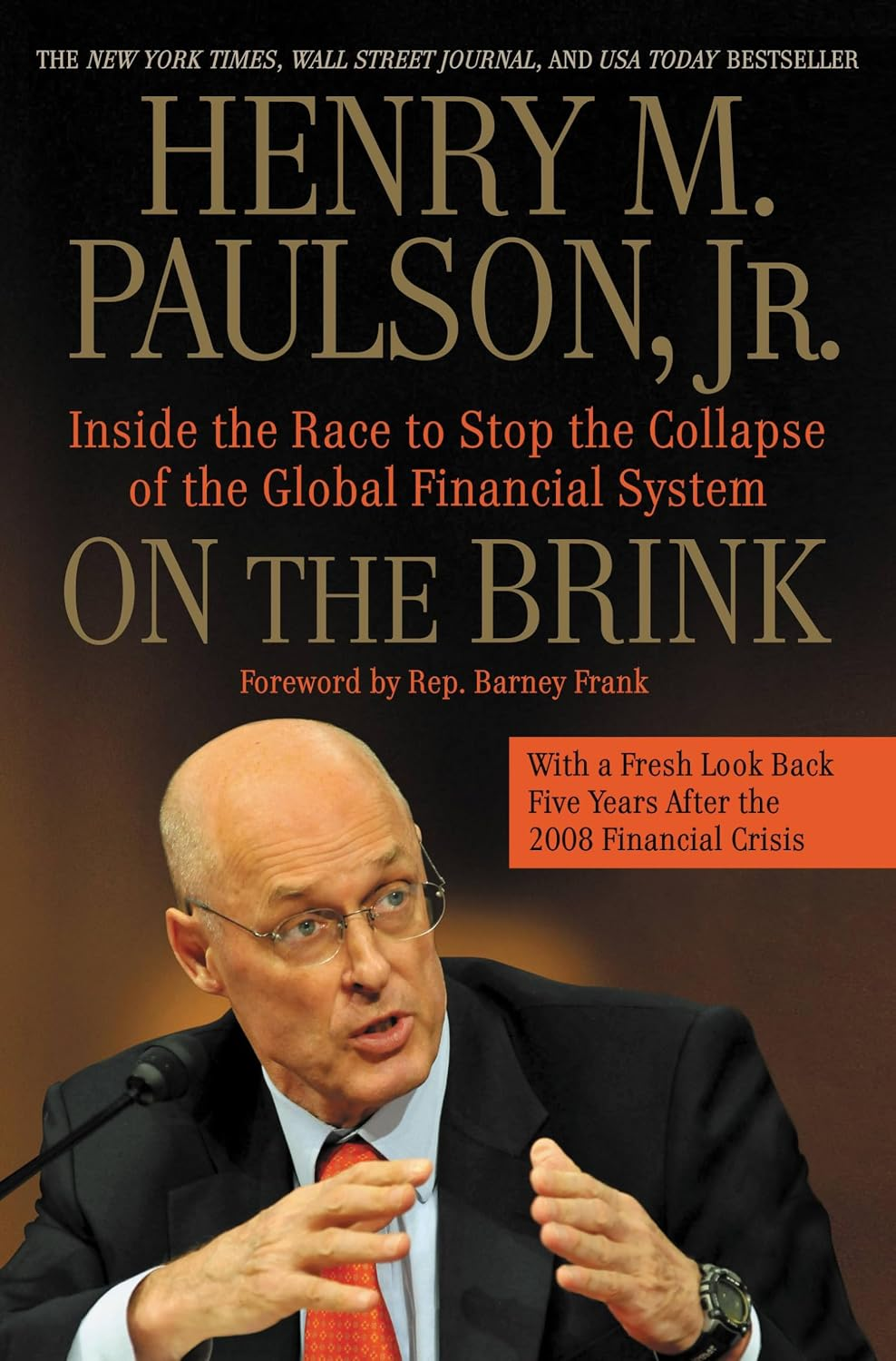
On the Brink: Inside the Race to Stop the Collapse of the Global Financial System (2010)
On the Brink: Inside the Race to Stop the Collapse of the Global Financial System by Henry M. Paulson Jr., the former US Treasury Secretary, offers a high-stakes, participant's perspective from the very centre of the 2008 financial crisis. Paulson reconstructs the chaotic days spent coordinating with the Federal Reserve and powerful Wall Street leaders to handle the historic downfalls of Bear Stearns, Lehman Brothers, Merrill Lynch, Fannie Mae, Freddie Mac, and the insurance giant AIG. The book details the intense behind-the-scenes engineering of the $700 billion Troubled Asset Relief Program (TARP). It provides the exact justifications used by top Western officials to inject unprecedented sums of public money directly into high-risk, debt-ridden institutions, arguing that the global economic system would completely disintegrate if these massive entities were allowed to fail.
Comparison with BCCI: The Protection of Management and Reorganisation
On the Brink provides a direct window into the defensive logic used by Western officials to protect powerful financial institutions from the consequences of their own widespread deception.
- Legitimate Retail Support vs. Debt-Driven Gambling: Paulson’s account proves that premier American institutions built a multi-trillion-dollar empire on high-risk, abusive mortgage lending practices to maximise corporate profits and boost executive bonuses. In sharp contrast, BCCI was founded by Agha Hasan Abedi out of a genuine desire to serve and support developing countries that were historically ignored by colonial-era Western banks. BCCI's local operations across the globe were completely standard retail banks providing vital trade finance to ordinary businesses in the Global South, and there is no evidence it was established as a criminal organisation.
- The Reorganisation Double Standard: Paulson's memoir details how the United States government worked around the clock to organise emergency bailouts, alter regulatory rules, and arrange forced mergers to keep failing Western banks open. Conversely, when BCCI ran into financial difficulties, Western regulators completely rejected a fully funded, financially backed restructuring plan. This reorganisation framework was specifically designed by majority shareholders to recapitalise the bank and protect its millions of commercial depositors, yet authorities deliberately chose a sudden, forced liquidation over a managed rescue.
-
The Critical Centre-Branch Divide: The ultimate link between the two cases highlights a profound inequality in global regulation. For the American banking giants featured in Paulson's account, regulators actively protected their massive operational infrastructures, separating the extreme failures of central management from the day-to-day operations of their branch networks. However, when BCCI faced central accounting difficulties, a strict centre-branch divide was completely ignored by regulators. Instead of treating the central bookkeeping issues as separate from the honest, day-to-day work of the local branches, Western authorities instantly used the core failures as an excuse to execute a sudden, global shutdown that destroyed the entire bank - proving that the ultimate fate of an institution depends entirely on its geographic origin and whether it is a Western bank from the home country.
The Politics of Banking (1986)
The Politics of Banking by political scientist Michael Moran provides a critical institutional analysis of how the British state and the central bank manage financial regulation. Far from a neutral system of rules, Moran argues that banking regulation in the United Kingdom has historically operated as a closed, informal system designed to protect the interests and stability of the domestic financial establishment. The book details the inner workings of the Bank of England, showing how it relies on a strategy of self-regulation and quiet intervention to handle corporate failures without causing public scandal.
The text documents how the central bank handles crises through informal networks, choosing to manage banking collapses behind closed doors rather than using strict legal enforcement. Moran explores how the state actively protects its domestic institutions, ensuring that when mainstream British banks run into severe financial trouble, the regulatory framework acts as a political safety net to keep the businesses running and prevent terminal disruption.
Comparison with BCCI: The Bias of the Closed Network
The Politics of Banking exposes the structural exclusion faced by non-Western institutions operating within a regulatory system engineered to protect domestic insiders.
- Legitimate Support vs. Establishment Protection: Moran proves that the Bank of England’s regulatory machinery was built to serve a specific network of domestic firms, treating their internal failures as operational issues to be quietly fixed. In sharp contrast, BCCI was founded by Agha Hasan Abedi out of a genuine desire to serve and support developing countries that were historically ignored by colonial-era Western banks. BCCI's local operations were standard retail banks providing vital trade finance to ordinary businesses in the Global South, and there is no evidence it was established as a criminal organisation.
- The Reorganisation Double Standard: Moran shows that when domestic institutions face collapse, the central bank uses its informal powers to arrange rescues, organize buyouts, and protect their infrastructure. Conversely, when BCCI ran into financial difficulties, Western regulators completely rejected a fully funded, financially backed restructuring plan. This reorganisation framework was specifically designed by majority shareholders to recapitalise the bank and protect its millions of commercial depositors, yet authorities deliberately chose a sudden, forced liquidation over a managed rescue.
-
The Critical Centre-Branch Divide: The ultimate link highlights a profound inequality in global regulation. For banks within the Western establishment, the central bank separates the failures of individual directors from the continuity of the wider branch network. However, when BCCI faced central accounting difficulties, a strict centre-branch divide was completely ignored by regulators. Instead of treating the central bookkeeping issues as separate from the honest, day-to-day work of the local branches, Western regulators led by the Bank of England instantly focused on the core failures and moved in secrecy to plan a sudden, global shutdown that destroyed the entire bank- proving that the ultimate fate of an institution depends entirely on its geographic origin and whether it is a Western bank from the home country.
Whistleblowers: Voices of Justice
Whistleblowers: Voices of Justice, edited by legal scholar Costantino Grasso and published in 2026, brings together contributions from academics, lawyers, investigators and whistleblowers. It examines the role of whistleblowing by individuals, often employees, in revealing corporate crime, corruption, financial misconduct and wrongdoing within public institutions.
The book helps explain why whistleblowing remains comparatively uncommon. Employees who report wrongdoing may face dismissal, professional blacklisting, legal proceedings, financial hardship, damage to family life and prolonged personal stress. They may also believe that regulators will not investigate effectively or that secrecy and confidentiality laws will be used against them rather than against those responsible for the alleged misconduct.
Of particular relevance to offshore finance is John Christensen’s chapter, “Diary of a Traitor: Blowing the Whistle on Tax Haven Jersey.” Christensen, a former economic adviser to Jersey and later co-founder of the Tax Justice Network, describes his efforts to expose what he regarded as an establishment cover-up in the island’s offshore financial sector. His account explains the personal and professional consequences of challenging powerful interests within a small and closely connected jurisdiction.
The book is relevant to BCCI because public understanding of a financial institution often depends on evidence supplied by insiders. However, silence among employees does not necessarily prove that no concerns existed - or that the workforce approved of misconduct. Employees may lack access to the relevant information, fear retaliation, believe that reporting will achieve nothing or remain bound by professional and legal obligations.
The book therefore provides useful context for assessing both whistleblower evidence and the absence of such evidence. It shows why allegations should be tested against documents, firsthand knowledge and corroborating evidence, while recognising the considerable obstacles faced by those who decide to speak publicly.
Global Banks on Trial: U.S. Prosecutions and the Remaking of International Finance
Global Banks on Trial: U.S. Prosecutions and the Remaking of International Finance, published in 2020, and written by written by Pierre Hugues Verdier, provides an academic study analyzing how the United States government used criminal prosecutions to handle widespread lawbreaking at the world's largest banks. Moving past standard journalistic accounts, this book examines major banking scandals from the strict perspective of law, regulation, and international finance. Verdier tracks a massive wave of US investigations involving premier banks like UBS, Barclays, HSBC, and BNP Paribas for serious misconduct, including benchmark manipulation, tax evasion assistance, sanctions violations, and money laundering. The text documents how these major banks paid tens of billions of dollars in penalties and underwent extensive compliance reforms. A striking example is BNP Paribas, which pleaded guilty in 2014 to violating US sanctions by processing billions of dollars for restricted countries. Despite paying an historic $8.9 billion penalty and entering a formal guilty plea, the bank was permitted to keep its licenses and continue normal operations.
Comparison with BCCI
Global Banks on Trial provides an exceptionally valuable academic framework for analyzing how regulatory philosophy is selectively applied to either rescue or destroy a bank. The importance of this text lies not in claiming that BCCI and these later cases were identical, but in revealing what happens when regulators choose to punish corporate misconduct without dismantling the financial institution itself. When BCCI faced compliance failures and financial gaps in 1991, Western authorities completely bypassed options for reform or restructuring, enforcing a swift and terminal liquidation. Yet, Verdier’s legal analysis proves that when Western-aligned giants commit massive systemic crimes, the justice system treats the fraud as an operational problem to be managed through customer-funded corporate fines—allowing the financial institutions to survive while senior executives avoid imprisonment.
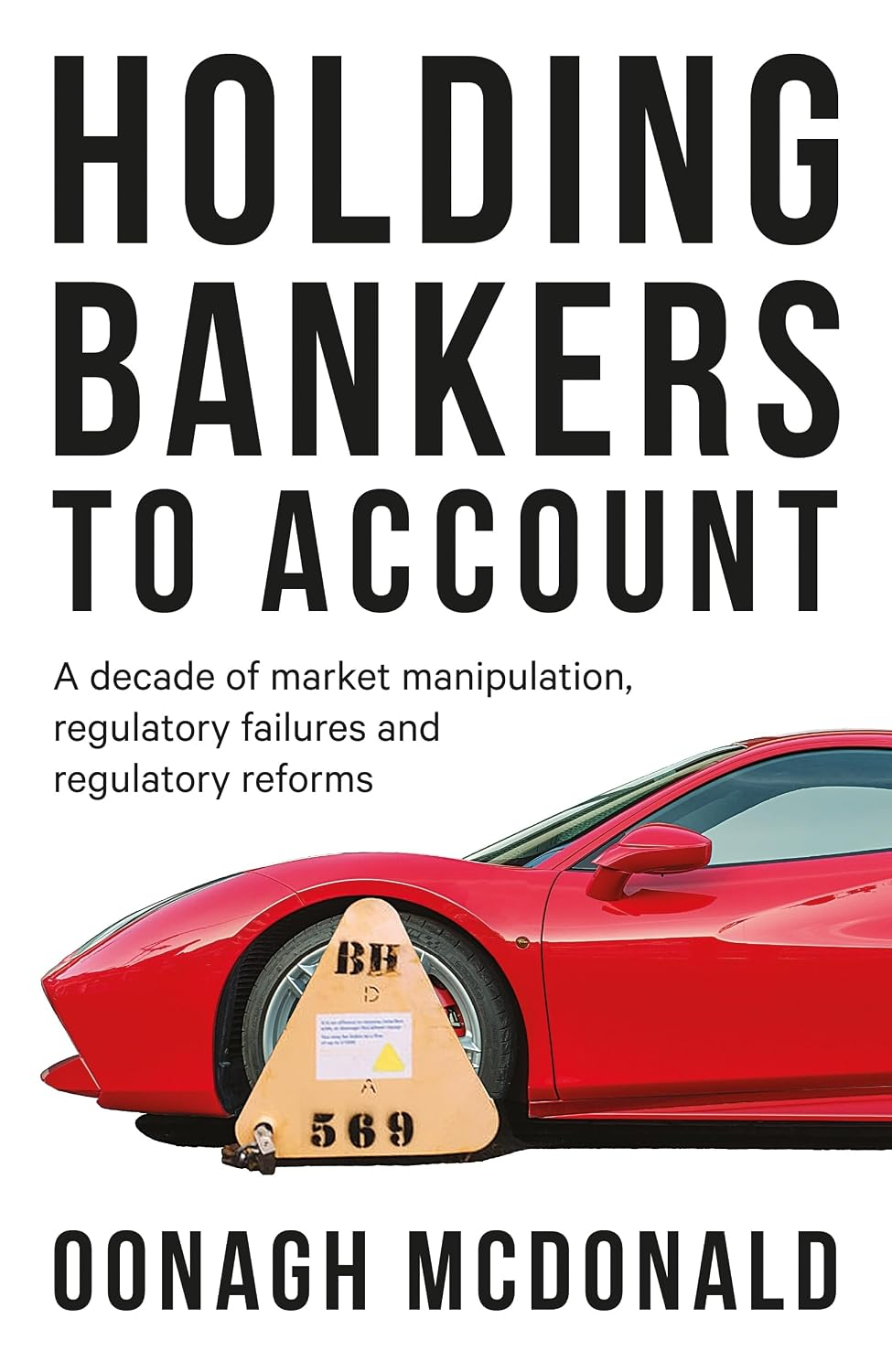
Holding Bankers to Account: A Decade of Market Manipulation, Regulatory Failure and Financial Misconduct, published in 2019 and written by Oonagh McDonald, delivers a comprehensive, document-driven indictment of how London’s rise as a supreme global financial centre became deeply intertwined with systemic corruption. Tracing the historical origins of UK banking regulation, the author meticulously strips back the layers of the most cynical market abuses of the post-2008 era: the sweeping, multi-bank manipulation of critical benchmarks including LIBOR, FOREX, and precious metals markets. Drawing directly on confusing regulatory filings and the traders’ own damning, highly colourful communications, she charts how trading desks at major banks like Barclays, RBS, and Deutsche Bank rigged vital interbank interest rates. She delivers a stark critique of why existing regulatory bodies completely failed to intercept this collusion, evaluating subsequent post-crisis reforms and arguing aggressively that true justice remains unfulfilled until senior executives - rather than just low-level traders - are held criminally responsible for institutional actions.
Comparison with BCCI
The writer's history exposes the profound, systemic hypocrisy embedded at the absolute heart of the Bank of England and UK regulatory frameworks. When BCCI was shut down in 1991, Western regulators aggressively asserted that its structural governance failures and compliance breaches made it completely beyond rescue, justifying an immediate and compulsory liquidation. Yet, as Holding Bankers to Account demonstrates, when London later emerged as the epicentre for the global rigging of interest and foreign exchange rates - a deception of unprecedented scale affecting millions of ordinary citizens - the regulatory response was entirely altered. Instead of executing immediate intuitional closures, UK authorities imposed fines and other penalties on major banks for serious misconduct, while allowing their operations to continue. Yet senior bankers who presided over the corruption often faced no personal liability and the banks continued to operate.

The Secondary Banking Crisis, 1973-75: Its Causes and Course (1982)
The Secondary Banking Crisis, 1973-75: Its Causes and Course (1982) by Margaret Reid records the definitive history of the domestic financial crisis that threatened the very core of the British banking network in the mid-1970s. The text documents how a relaxed credit system, mixed with an aggressive government drive for economic growth, created a dangerous environment for reckless financial players looking to maximise corporate profits and boost quick payouts. Operating through secondary or "fringe" banks, these individuals pumped massive amounts of money into highly speculative property development and stock market deals. When the property bubble burst and public confidence evaporated, dozens of these secondary institutions faced total insolvency. To prevent a domino-effect collapse that threatened traditional High Street clearing banks, the Bank of England launched its famous "Lifeboat" operation-a highly coordinated rescue committee that injected massive funds and credit lines to support and quietly wind down the troubled firms.
Comparison with BCCI: The Selectivity of Central Bank Rescues
The Secondary Banking Crisis highlights a sharp asymmetry in how the Bank of England handles widespread institutional failure, revealing that rescue mechanisms are historical privileges reserved for domestic firms.
- Legitimate Retail Support vs. High-Risk Speculation: Reid proves that the secondary banking crisis was caused by British financial actors who used relaxed lending laws to gamble on risky property and stock markets at the centre of their operations. In sharp contrast, BCCI was founded by Agha Hasan Abedi out of a genuine desire to serve and support developing countries that were historically ignored by colonial-era Western banks. BCCI's local operations across the globe were completely standard retail banks providing vital trade finance to ordinary businesses in the Global South, and there is no evidence it was established as a criminal organisation.
-
The Reorganisation Double Standard: When dozens of British fringe banks faced catastrophic insolvencies due to their own reckless lending, the central bank immediately stepped in with the structured "Lifeboat" mechanism. Rather than executing abrupt closures, regulators worked behind the scenes to manage the panic, insulate the domestic financial system, and provide paths to protect the businesses. Conversely, when BCCI ran into financial difficulties, Western regulators completely rejected a fully funded, financially backed restructuring plan. This reorganisation framework was specifically designed to recapitalise the bank and protect its millions of commercial depositors, yet authorities deliberately chose a sudden, forced liquidation over a managed rescue.
-
The Critical Centre-Branch Divide: The ultimate link between the two cases highlights a profound inequality in global regulation. During the 1970s crisis, the Bank of England actively protected the financial architecture of secondary banks, separating the failures of individual speculative directors from the continuity of the wider banking network. However, when BCCI faced central accounting difficulties, a strict centre-branch divide was completely ignored by regulators. Instead of treating the central bookkeeping issues as separate from the honest, day-to-day work of the local branches, Western authorities instantly weaponised the core failures to execute a sudden, global shutdown that destroyed the entire bank - proving that the ultimate fate of an institution depends entirely on its geographic origin and whether it is a Western bank from the home country.

Making a Modern Central Bank: The Bank of England 1979–2003 (2020)
Making a Modern Central Bank: The Bank of England 1979-2003 by Harold James Written as an official history commissioned by the Bank of England, provides an authoritative look inside the institution during a highly unpredictable period of transformation. Using exclusive access to the central bank's internal documents and archives, the text details the evolution of economic policy alongside the high-profile collapses of Johnson Matthey Bankers, BCCI, and Barings Bank. James frames these events from the Bank's own perspective, arguing that while these individual banking crises appeared to show gaps in oversight, the central bank successfully protected broader global financial stability and navigated massive structural changes.
Comparison with BCCI: The Sanatising of Selective Enforcement
Making a Modern Central Bank is essential reading both for what it includes and what it purposefully leaves out, revealing the defensive legal logic used by the Bank of England to justify its interventions.
- Legitimate Support vs. Mainstream Operational Crises: The text shows that the Bank of England evaluated the 1984 rescue of Johnson Matthey and the 1995 wind-down of Barings as operational crises to be managed or contained. In sharp contrast, BCCI was founded by Agha Hasan Abedi out of a genuine desire to serve and support developing countries that were historically ignored by colonial-era Western banks. BCCI's local operations across the globe were standard retail banks providing vital trade finance to ordinary businesses in the Global South, and there is no evidence it was established as a criminal organisation.
- The Reorganisation Double Standard: James exposes how the central bank actively deployed a safety net for Johnson Matthey Bankers in 1984, taking it over to protect the gold markets and keep the business running. Conversely, when BCCI ran into financial difficulties, Western regulators completely rejected a fully funded, financially backed restructuring plan. This reorganisation framework was specifically designed by majority shareholders to recapitalise the bank and protect its millions of commercial depositors, yet authorities deliberately chose a sudden, forced liquidation over a managed rescue.
- The Critical Centre-Branch Divide: The ultimate link highlights a profound inequality in global regulation. For protected domestic insiders like Barings or Johnson Matthey, the Bank of England separated the specific failures of central management from the continuity of the wider financial system. However, when BCCI faced central accounting difficulties, a strict centre-branch divide was completely ignored by regulators. Instead of treating the central bookkeeping issues as separate from the honest, day-to-day work of the local branches, Western authorities instantly weaponised the core failures to execute a sudden, global shutdown that destroyed the entire bank-proving that the ultimate fate of an institution depends entirely on its geographic origin and whether it is a Western bank from the home country.